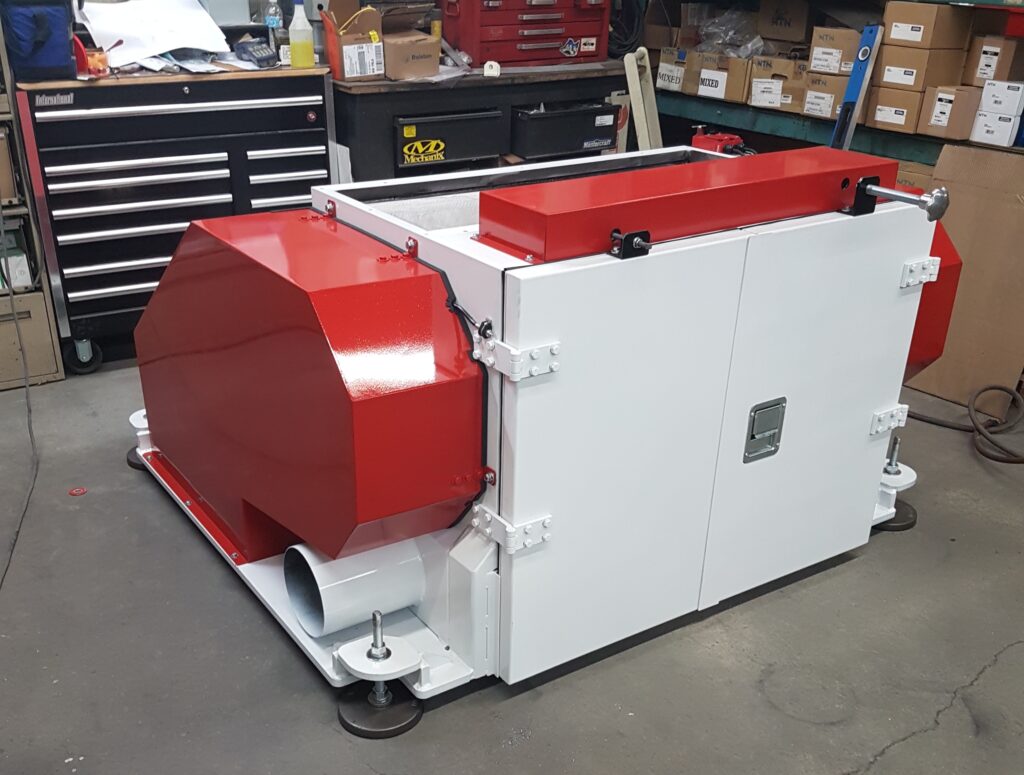
Canadian size reduction manufacturer Rotogran International has launched a newly designed severe duty granulator for use in stacked shredder/granulator applications.
“The message was clear: the granulator needs to be both strong and durable to stand up to steady shock loading operation over the long haul,” says Mike Cyr, President of Rotogran, the Ontario-Canada based equipment supplier for the plastics and recycling industry.
Rotogran’s WO-2260-XHD Severe Duty Granulator was designed, with every major component reinforced, to absorb and withstand repeated shock loading, thus significantly extending the overall life of the equipment.
The Issue with Stacking
The concept of stacking a shredder on a granulator was developed as a solution to save valuable floor space in terms of integrated design and fewer pieces of equipment required for the process.
However, shredders and granulators are fundamentally different types of machinery with several different design and operational considerations. These differences must be addressed to prevent serious problems over time.
Granulators working with shredders are generally sized to meet a customer’s required production rate. The industry standard measurement for this is pounds per hour (lbs/hr). For granulators, this rate should be achieved as uniformly distributed material flow over the daily production time.
What generally happens is that an operator dumps a full gaylord of material into the stacked combo or loads up a standalone shredder (when equipped with a discharge conveyor) and walks away. The shredder immediately processes the entire load, and as the shredder is unable to uniformly process the load, instead it floods the granulator below with a massive shock load and then sits idle until the next load arrives.
“During this cycle of shock loading the granulator is processing material at four to six times its designed production rate,” Cyr says. “Most granulators are built to be uniformly fed at a specified rate and not designed to absorb large shock loads for a short time then wait idle for the next one.”
This constant on-and-off overloading severely shortens the life of the granulator and increases downtime due to unexpected repairs.
Rotogran’s Solution: The WO-2260-XHD Severe Duty Granulator
Rotogran engineered a purpose-built solution, the WO-2260-XHD Severe Duty Granulator. This model is designed from the ground up for placement and integration under a shredder and produced with all the considerations necessary for under shredder applications.
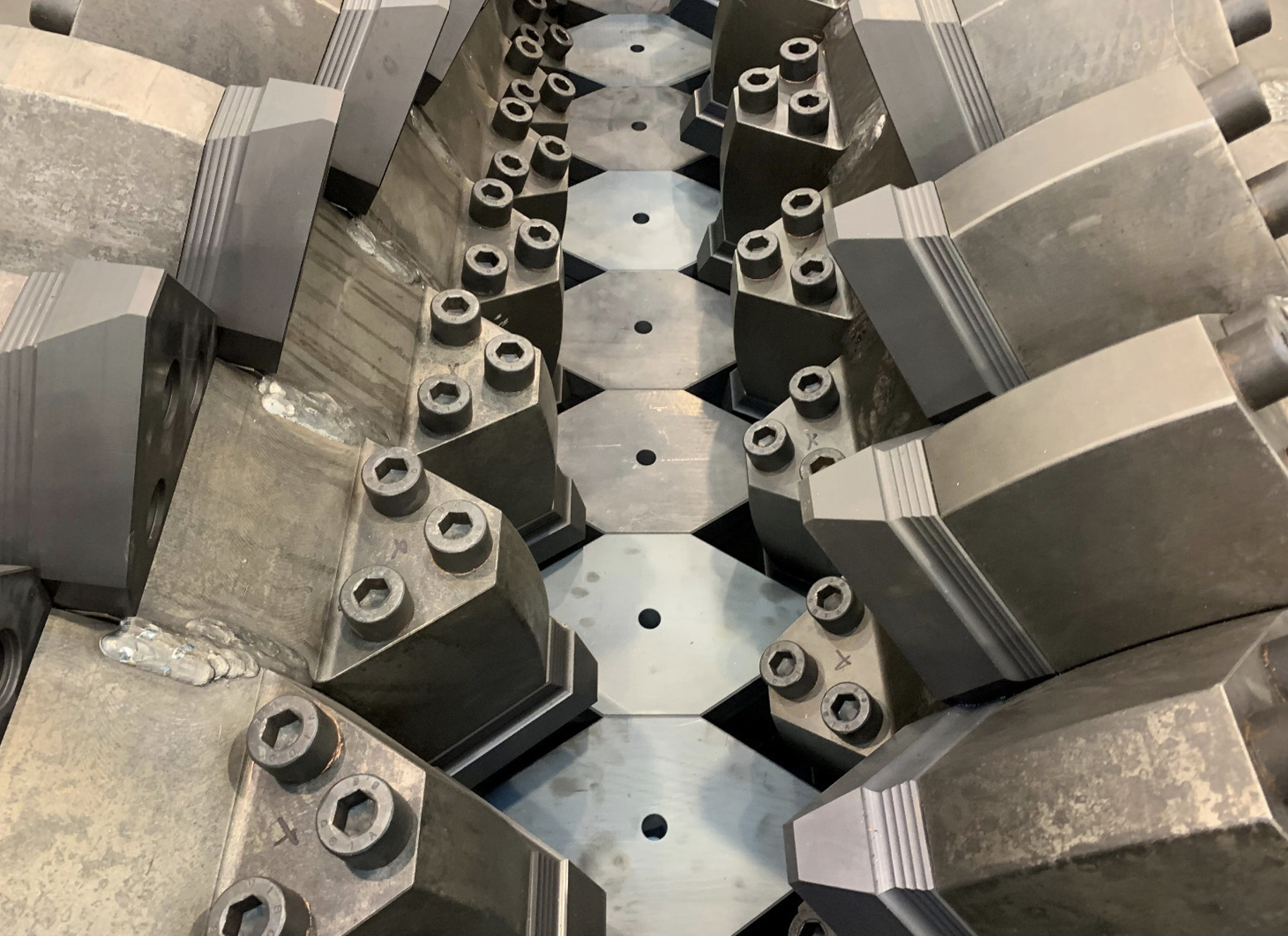
The rotor has 20% more mass and 15% larger shaft diameter. The solid knife mounting seats on the rotor are machined directly into solid heavy bars spanning the entire width of the granulator, creating a heavy-duty rotor with increased strength, reduced deflection, and improved fatigue failure performance. The stationary blade mounting blocks (top and bottom) are heavily reinforced for severe duty application. Rotor bearing diameter is increased by 13%, with all related power transmission components upsized accordingly.
The cutting chamber and frame received equal attention. The granulator frame structural tubing is larger in cross section with double the wall thickness. Standard granulator frame closures (back and sides) are changed from sheet metal construction to solid 3/8” thick laser-cut profiles.
Together, these design upgrades increase overall strength, rigidity, and fatigue failure performance by approximately 30%. Machine weight increased from 9,500 lb. to 13,500 lb.
Proven Results
Rotogran currently has several WO-2260-XHD granulators in integrated granulator-under-shredder applications. These granulators successfully replaced other standard granulators that failed in this application and are performing without issue.
“We’ve seen these failures firsthand, and that’s why we built this machine,” Cyr says. “The industry has been focused on throughput ratings, but that’s not the issue. The granulator must be strong enough to withstand the severe and unique demands of the integrated shredder/granulator application.”
“We changed that. We built this design to solve the problem in the field, and the results prove it,” he says.