Market

Rubber Recycling

Rubber recycling refers to processing irreparably damaged or worn-down (natural or synthetic) rubber products for new use to prevent rubber waste from ending up in a landfill. The process of reclaiming and repurposing rubber requires less energy compared to producing?

Latest in this market

Rubber Recycling news and case studies

All articles in this market
Independent editorial selection ? no sales pitches. Sponsored items are marked as such. Submit your news

Promoted videos

Rubber Recycling in action

All videos

Ask the Expert

Ask a rubber recycling expert ? free

Engineers and product specialists who answer technical questions from readers. The answer comes back to you by e-mail; when we publish it, other readers benefit too.

View all experts

Market & Technology Focus

Rubber Recycling, in depth in your inbox

Every Thursday edition takes one market or technology in depth. These are the editions on this market ? read them online or get the next one by e-mail.

Subscribe to our E-newsletters

Join 28,000+ engineers, plant managers and technical buyers. Free, twice a week.

What this market covers

Frequently asked about rubber recycling

What happens to scrap tires once they enter the recycling stream?

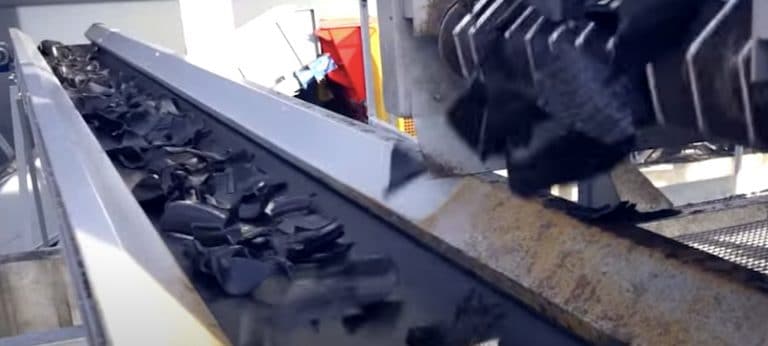
Whole tires are first shredded into rough chips, then run through granulators and magnetic separators to strip out embedded steel belting, and finally reduced further into crumb rubber through mechanical grinding or cryogenic freezing followed by fracturing. The resulting crumb is screened by particle size for use in products like playground surfacing, asphalt rubber, or molded goods.

Why does scrap rubber need dedicated handling instead of going into general waste?

Whole tires are bulky, don't compact well in landfills, and can trap methane gas or become breeding sites for mosquitoes when stockpiled, which is why many jurisdictions restrict or ban landfilling whole tires outright. Rubber's vulcanized structure also doesn't break down naturally the way many other materials do, so it needs specialized shredding, devulcanization, or pyrolysis equipment rather than standard waste processing.

What is devulcanization and how does it differ from simple shredding?

Shredding just reduces tire or rubber material to smaller physical pieces without changing its chemical structure, so the rubber stays cross-linked and can only be used in applications like crumb infill or mulch. Devulcanization breaks the sulfur cross-links formed during the original vulcanization process, restoring some of the rubber's elasticity and processability so it can be reintroduced as a raw material into new rubber compounds rather than just used as filler.

What products are made from recovered rubber and crumb rubber?

Crumb rubber is widely used in playground and athletic field surfacing, as an additive in asphalt rubber for road paving, and in molded products like mats, mulch, and flooring tiles. The recovered steel belting from tire shredding is sold as scrap metal, while the nylon or polyester fiber fraction is typically separated out and, depending on quality, may go to fiber recovery or be landfilled as residual.

What equipment is used to process rubber and tires at industrial scale?

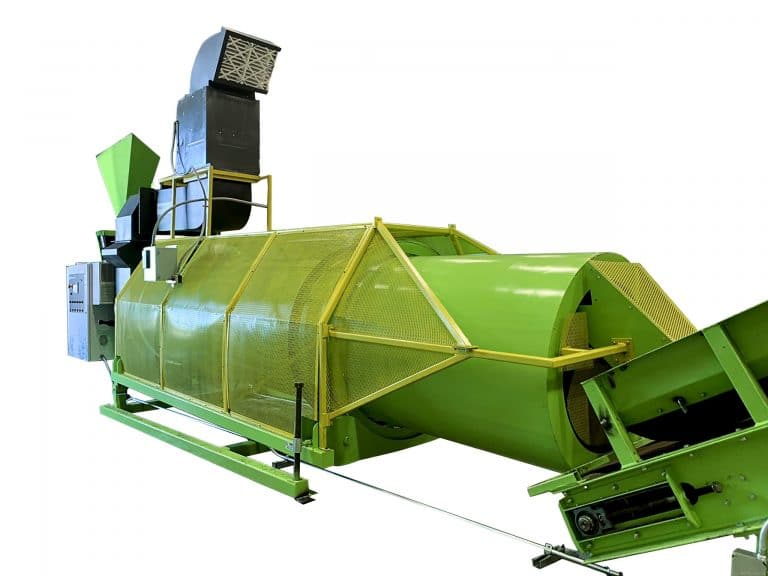
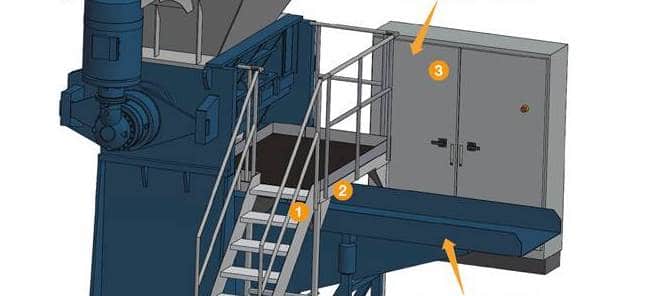
Primary shredders and tire cutters reduce whole tires to chips, which then pass through granulators, magnetic separators for steel, and air classifiers or screens to separate out fiber and size the crumb rubber. Pyrolysis units, which thermally decompose rubber in an oxygen-free chamber, are also used to convert scrap tires into recovered carbon black, pyrolysis oil, and steel, rather than mechanically grinding them into crumb.

How does tire pyrolysis work and what does it produce?

Pyrolysis heats shredded tire material in the absence of oxygen, breaking the rubber compound down into recovered carbon black, a hydrocarbon-rich pyrolysis oil, syngas, and residual steel. The oil can be refined further or used as a fuel substitute, while recovered carbon black can potentially be reused as a filler in new rubber or plastic compounds, though its quality varies depending on the feedstock and process control.

Is non-tire rubber, like industrial hoses or gaskets, recycled the same way as tires?

Not always — non-tire rubber often contains different fillers, reinforcing fabrics, or bonded metal fittings that complicate shredding and can contaminate crumb rubber streams meant for tire-derived products. Some non-tire rubber scrap is processed separately through dedicated grinding lines or diverted to pyrolysis or tire-derived fuel applications where material purity is less critical.

What regulations apply to scrap tire and rubber disposal?

Many US states operate scrap tire management programs that require registered haulers and processors, track tire generation and disposition, and in some cases charge a disposal fee at the point of sale to fund recycling infrastructure. Because whole tires are widely restricted from landfill disposal, generators typically must document that tires are sent to a permitted processor, recycler, or tire-derived fuel facility.

What are the environmental and economic benefits of recycling rubber instead of stockpiling or landfilling it?

Recycling scrap tires eliminates the fire and vector-breeding risks of large tire stockpiles and keeps bulky, slow-degrading material out of landfill airspace. Crumb rubber, tire-derived fuel, and pyrolysis products also create real revenue streams for processors, while asphalt rubber and molded rubber products reduce demand for virgin rubber and petroleum-based materials.

What trends and technologies are shaping the rubber recycling market?

Demand for asphalt rubber in road construction and for crumb rubber in synthetic turf and playground surfacing continues to drive investment in higher-throughput granulation and cryogenic grinding capacity. At the same time, devulcanization and advanced pyrolysis technologies are gaining attention as ways to recover higher-value rubber and carbon black rather than settling for lower-grade crumb, though scaling these processes cost-effectively remains an active challenge for the industry.

Reach the rubber recycling audience

A basic listing in the Manufacturers Directory is free. Advertising and Partner placements add visibility across the site and in the Weekly E-Update.

Advertise with us