
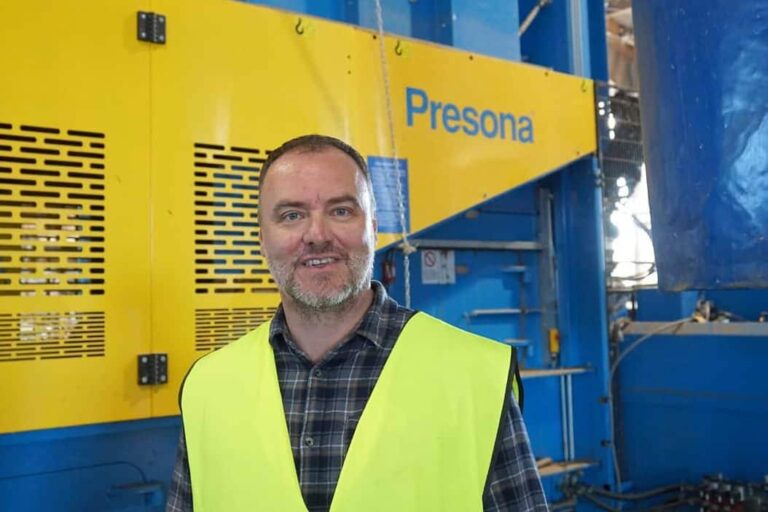
WMS Nordic Chose Presona for Flexibility and Outstanding Service (Video)
WMS Nordic AB is growing and wants to grow even more. To get there, the company needed more baling capacity, greater flexibility and good service close at hand.…


Market
Paper recycling can be defined as the environmentally friendly process of recovering and processing scrap and waste paper to create new paper products. Rigorous scientific research has demonstrated that manufacturing paper with recycled content has significant environmental and economic benefits.
Latest in this market
WMS Nordic AB is growing and wants to grow even more. To get there, the company needed more baling capacity, greater flexibility and good service close at hand.…



Promoted videos
Ask the Expert
Engineers and product specialists who answer technical questions from readers. The answer comes back to you by e-mail; when we publish it, other readers benefit too.
 Ivan Hondekyn
Valvan nv
Ivan Hondekyn
Valvan nv
Ivan Hondekyn has been part of the Valvan team for over 25 years, bringing a rare depth of expertise across design, project…
Ask a question Angelo Minoldi
HSM GmbH + Co. KG
Angelo Minoldi
HSM GmbH + Co. KG
Angelo Minoldi is working in the environmental technology sector for almost 25 years, 20 years of that in the baling presses sector.…
Ask a question Dan Fairest
M&J Recycling
Dan Fairest
M&J Recycling
At M&J Recycling, my role as the UK & ROI Sales Manager centres on providing top-tier shredding solutions tailored to the waste…
Ask a question Daniel Wresnik
UNTHA shredding technology
Daniel Wresnik
UNTHA shredding technology
Daniel Wresnik, Head of Sales and Business Development BU Waste & Recycling in the DACH region at UNTHA, is a proven expert…
Ask a questionMarket & Technology Focus
Every Thursday edition takes one market or technology in depth. These are the editions on this market — read them online or get the next one by e-mail.
Recycling technology worth your time: new equipment, plant case studies and the numbers behind them. Free, twice a week.
Questions and answers
Recovered paper is sorted into grades such as old corrugated containers, sorted office paper, mixed paper, and old newspapers, each with different fiber length, brightness, and contamination tolerances that determine what it can be remanufactured into. Higher grades like sorted white office paper command better prices and can be made back into printing paper, while mixed grades typically go into lower-value products like tissue or paperboard.
Recovered printed paper is pulped with water and chemical agents that loosen ink particles from the fiber surface, then the slurry is run through flotation cells where air bubbles carry the freed ink to the surface as foam to be skimmed off. The remaining deinked pulp is washed, bleached if needed, and screened before being formed into new paper, and this step is essential for producing bright printing and writing paper from recovered fiber.
Baled recovered paper is loaded into a pulper where water and mechanical agitation break the sheets down into a slurry of loose fiber, similar to the process used for cardboard but generally run at conditions tuned for shorter, more delicate fibers. The slurry then passes through cleaning and screening equipment that removes staples, plastic, and other debris before the fiber is refined and formed into new paper sheets.
Plastic envelope windows, laminated or plastic-coated paper, adhesive labels, and thermal receipt paper coated with chemical developers are among the most persistent contamination problems, since they don't break down during pulping and can either clog equipment or show up as visible specks in the finished sheet. Paper mills rely on screening and cleaning stages to remove what they can, but heavily contaminated loads reduce pulp yield and quality.
Each time wood fiber goes through the recycling process it loses some length and strength, and paper fiber is generally estimated to withstand somewhere around five to seven cycles before it becomes too short and weak for papermaking. That's why virgin fiber is continually introduced into the overall paper stream to maintain the fiber quality needed for stronger products.
Baled recovered paper is broken down in pulpers, then run through cleaners, screens, and flotation deinking cells that remove contaminants and ink, followed by refiners that condition the fiber before it's formed into new sheets on a paper machine. Sorting facilities upstream also use optical scanners and screens to separate paper grades and pull out plastic and other non-fiber contaminants before baling.
Recovered paper grades are defined by industry specifications, such as those published by the Institute of Scrap Recycling Industries (ISRI), which set allowable limits on moisture, prohibitive materials, and outthrows for each grade to give mills consistent purchasing standards. Paper intended for food-contact packaging is also subject to additional regulatory limits on contaminants that could migrate into food.
Producing paper from recovered fiber uses significantly less energy and water than pulping virgin timber and reduces the volume of paper sent to landfill, where decomposing paper generates methane. Recovered fiber also gives mills a lower-cost, more price-stable feedstock alternative to virgin pulp, which has become increasingly important as demand for packaging-grade paper has risen with e-commerce growth.
No — thermal receipt paper, carbon paper, and heavily laminated or wax-coated paper are generally not recyclable through standard mill processes because their coatings and chemical developers interfere with pulping and deinking. Shredded paper is also harder to recycle at scale since its short fiber fragments are difficult to capture in sorting equipment, and some mills limit how much shredded paper they'll accept.
Declining office and newsprint use from digitalization has reduced the supply of some traditional high-grade recovered paper, even as demand for recovered fiber in packaging paper has grown alongside e-commerce shipping volumes. Mills are also investing in more advanced optical sorting and deinking technology to process a more variable, contamination-prone stream as curbside collection mixes more paper grades together.
Use the Manufacturers Directory A–Z or the Equipment Guide. Partner profiles carry direct contact details; other listings link to the company website.
Yes. Ask the Expert puts your question to a field expert active in Paper Recycling. The answer comes back to you by e-mail; when we publish it, other readers benefit too.