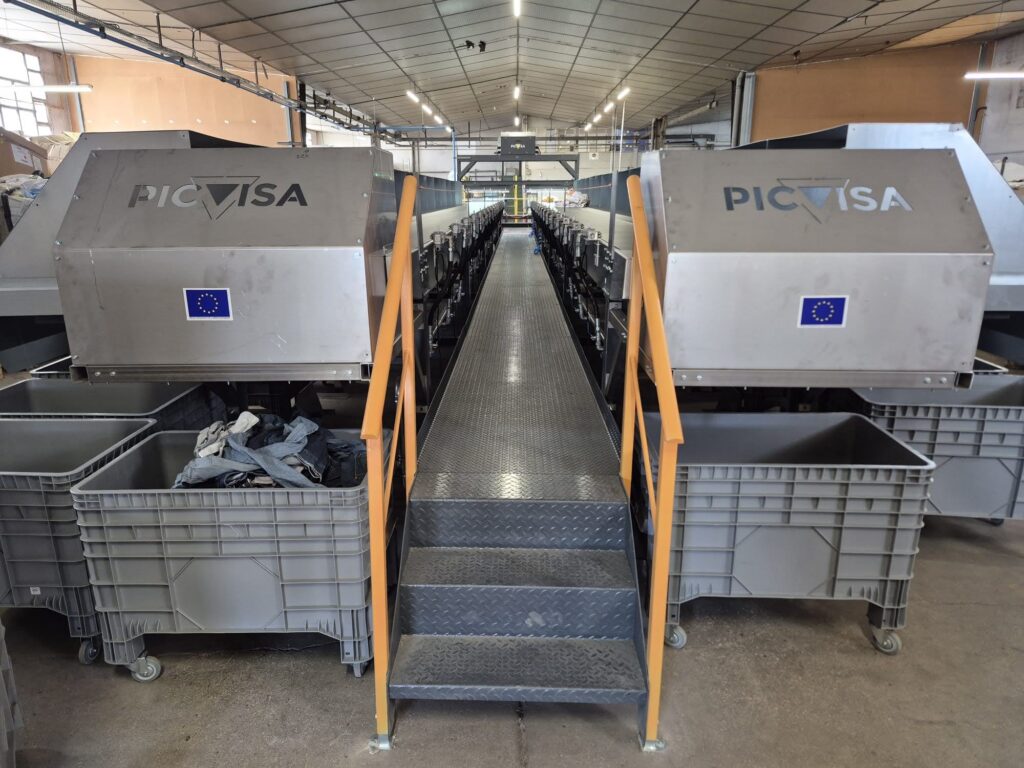
Walk into the ESSAIMONS facility on Rue Louis Blériot in Châtellerault, in France’s Nouvelle-Aquitaine region, and you are confronted with one of the most technically demanding problems in the circular economy: a conveyor belt carrying a relentless stream of worn garments — from threadbare cotton T-shirts and polyester blouses to nylon hosiery and elastane-laced sportswear — arriving in bales of up to 500 kilograms, still damp in places, wildly inconsistent in size and weight, and destined, if the technology works as promised, for a second life as regenerated fibre. The system making that promise real is ECOSORT TEXTILE, developed by PICVISA, a Barcelona-based specialist in AI-driven optical sorting. Combining near-infrared (NIR) spectroscopy, RGB vision cameras and machine-learning algorithms, it identifies fibre composition in real time at a rate of roughly one garment per second. For an industry long reliant on manual graders squinting at care labels — when labels are present at all — that is a meaningful shift.
The Challenge: Heterogeneity at Scale
ESSAIMONS is a up-sorting and preparation company promoted by PLAXTIL, a French pioneer in textile recycling founded in 2020. PLAXTIL’s industrial model depends on receiving sorted, composition-verified textile streams to feed downstream regeneration processes — and that requires a level of granularity that manual labour cannot deliver cost-effectively at scale.
The material arriving at the plant is a case in complexity. It comes from second-hand stores, professional laundries and post-consumer collection schemes. Individual items range from small rags weighing as little as 20 grams to king-size bedsheets approaching 2 kg. Some arrive dry, some wet. Many are multi-layered or double-woven — precisely the construction that confounds spectrometric readings, since the sensor captures the outermost fabric rather than the composite whole.
The client’s requirement was unambiguous: classify garments by exact fibre percentage — cotton, polyester, elastane and beyond — with a maximum classification error of 10 percent. Not approximately. Across a matrix of more than 25 target fractions, from pure PET and pure cotton to complex blends involving aramid, viscose, nylon and wool, plus nine colour categories. The goal of ESSAIMONS: to meet the very specific demands of all Tex to Tex recyclers and in particular, that of chemical recyclers.
The Technology: NIR Meets Machine Learning
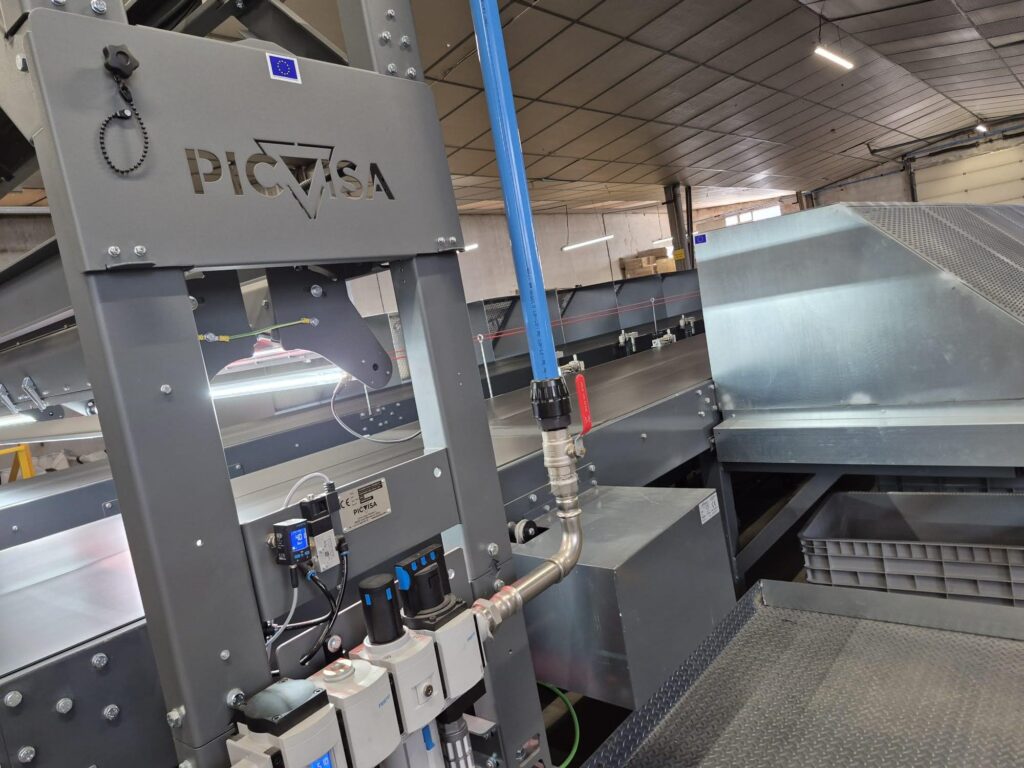
The ECOSORT TEXTILE is built around a 1,000-millimetre working-width optical head integrating NIR and RGB sensing under spectral illumination. A continuously updated spectral textile library allows the system to identify 11 fibre types and their blends in fractions of a second, feeding a dual-track configuration with 15 compressed-air ejection valves per track. Line capacity runs between 1 and 1.2 tonnes per hour.
PICVISA’s scope goes well beyond hardware. At ESSAIMONS, the full installation includes conveyors, tipping stations, reception tables, maintenance infrastructure and spectral lighting, alongside the software platform with regular updates and the spectral library itself. A two-year maintenance contract is built in. And in April 2026, the system is scheduled to upgrade to PICVISA’s Ecoexpert platform — a development that removes current limitations on the number of sortable classes, critical for a client whose classification matrix is already among the most detailed in the industry.
Why It Matters
The European EPR framework for textiles is tightening, and with it the demand for verified-composition recycled streams suitable for fibre-to-fibre processes. The bottleneck issue has never been whether recycled cotton or polyester can replace virgin inputs — it can. The problem has always been supply: getting enough consistently-sorted, composition-verified material into the system.
What PICVISA is demonstrating at Châtellerault is that AI-driven NIR sorting can address that bottleneck at genuine industrial throughput. The ability to distinguish 80% cotton from 90% cotton, separate denim from other cellulosic blends, or isolate nylon-elastane mixes opens sorting pathways that were not previously economically viable.
The ESSAIMONS installation is the foundation of our future. But as EPR obligations push more post-consumer textiles into collection networks, and the economics of chemical recycling continue to improve, demand for this kind of precision sorting infrastructure will only grow. PICVISA’s answer, operational in western France, is that the technology is already here.
The ECOSORT TEXTILE system at ESSAIMONS, Châtellerault, is currently operational. The Ecoexpert platform upgrade is scheduled for April 2026.