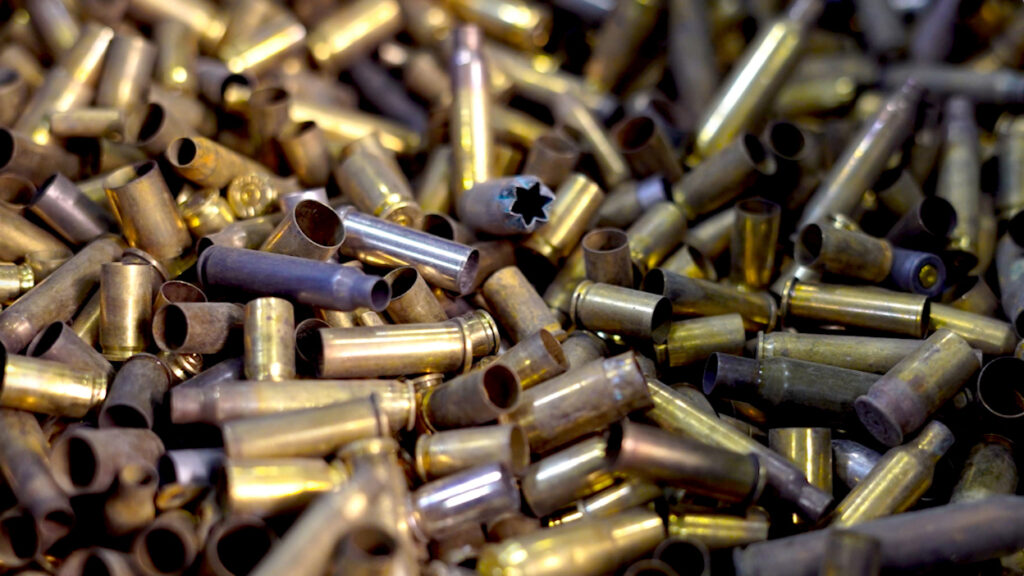
For brass recyclers, crushing these brass shell casings prior to shipping or other downstream recycling operations can have a lot of value depending on how much material they handle, how far it needs to move, and what the next buyer wants.
Although a fired casing is, in simple terms, empty metal, they take up a disproportionate amount of space relative to their weight. Crushing them reduces volume, which makes them easier to handle, lowers storage demands, and can greatly reduce transportation costs.
“For brass recyclers moving large quantities over long distances, crushing cuts the volume way down so you are not shipping air. These efficiencies can result in a reduced number of shipments overall or allow each truckload to be utilized more effectively, maximizing transport value and lowering total logistics costs,” says John Neuens, industrial consultant at BCA Industries. BCA provides complete custom recycling systems for complex industrial and commercial applications.
Crushed casings are also easier to feed into hoppers, conveyors, balers, or shredders used in industrial scrap processing. What happens downstream of the brass recycler matters too. Some smelters prefer crushed or compacted brass because it is easier to load when charging a furnace and there are less complications from air pockets.
Large industrial recyclers or specialty processors that contract directly with agencies or defense-related contractors may also be required to crush brass casings as part of the demilitarization (demil) requirements to render casings unfit for reloading.
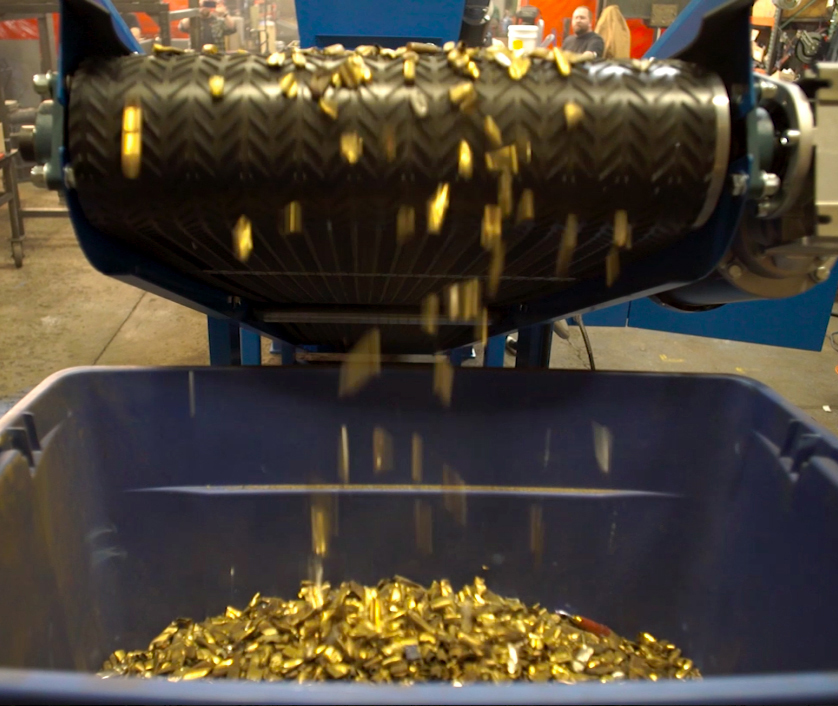
This work is typically done with roller mills and other types of crushing equipment used in scrap handling and metal recycling, allowing large volumes of cartridge cases to be processed efficiently. The compression of the shells size also allows for less expensive freight charges to the recycler.
Although crushing spent brass casings is a relatively simple process, there is always the possibility that an unfired round could enter the recycling stream. The concern is that a live cartridge could discharge under pressure and create a safety hazard.
However, according to Neuens, the actual risk is minimal. When a round is not confined in a firearm chamber, its energy is limited, and modern roller mills used for this work incorporate design features that contain the event and prevent any release beyond the crushing chamber.
Recycling Challenges
In recycling operations, loose brass casings present handling challenges because they are hollow, resilient, and prone to interlocking. A roller mill addresses these issues by collapsing the casings’ structure, flattening them or partially cracking them so they behave more like solid scrap.
“The operating principle is straightforward,” says Neuens. “Brass casings are fed continuously into a pair of counter-rotating steel rollers. The rollers are set with a controlled gap that is narrow enough to crush and flatten the casings without excessively fragmenting them.”
In this application, roller mills function more like heavy-duty crushers than grinders. The rollers are often hardened and wear-resistant to accommodate brass that may contain dirt, primer remnants, or other contaminants.
BCA’s Cartridge Crusher RLLR-4001-0001 Roller Mill is an industrial-grade solution engineered to streamline the processing of spent ammunition casings for efficient recycling and material handling.
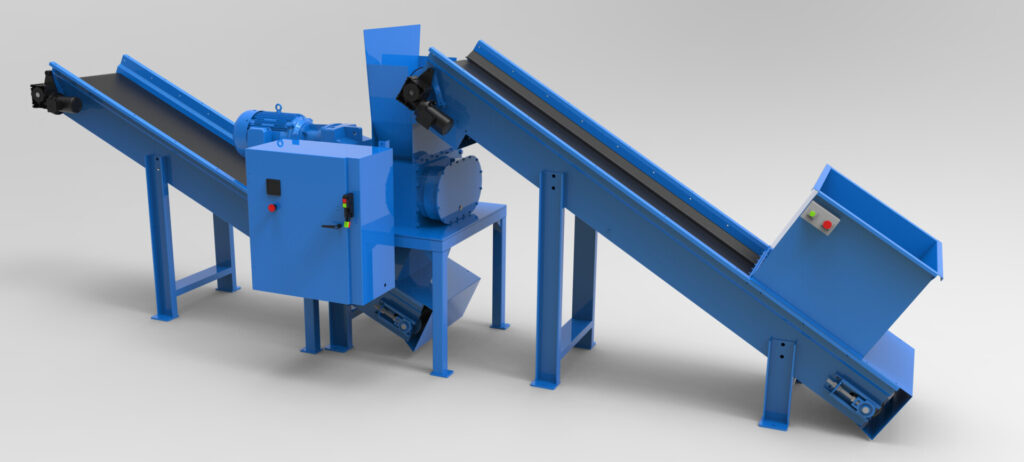
Built with a robust dual-roller system, the machine compresses and crushes spent shells quickly and consistently, significantly reducing their volume for easier storage, transport, and metal reclamation.
Manufactured entirely in the United States, the RLLR-4001-0001 features a generously sized hopper capable of accepting a wide range of casing sizes from .22 caliber through .50 caliber, allowing continuous, uninterrupted processing.
An integrated magnetic separation system further improves efficiency by automatically removing ferrous components before crushing, ensuring that recovered materials are cleaner and more valuable for downstream recycling processes.
According to Neuens, safety considerations remain critical in systems handling cartridge brass. However, the equipment is specifically engineered to safely process material even in the presence of live rounds, minimizing risk.
To do this, Neuens explains that the entry area of the roller mill is engineered with internal baffling designed to fully contain fragments, ensuring that no particles can escape.
“Gunpowder in a cartridge is meant to burn and create gas, not explode like a bomb,” explains Neuens. “In a gun, the chamber and barrel trap that gas so pressure builds behind the bullet and pushes it to high speed. Without that confinement, the gas expands in all directions. If a round ignites outside a chamber, there’s no strong, focused pressure.”
The roller mill is available in several scalable configurations, including a compact, self-contained mobile unit.
Many brass recyclers prefer a mobile unit so they can crush casings on-site. This reduces material handling, minimizes logistical complexity, and can substantially decrease overall shipping expenses. The system is also available in a containerized configuration to protect personnel during operation and simplify transport.
“These configurations are well suited for operations that travel to multiple locations, allowing shells to be crushed at the customer’s site rather than transported between facilities. That way, the material can be processed immediately before it’s shipped,” says Neuens.