Closed PVC Loop in Window Profile Production: Technology, Economic Efficiency and Climate Protection in Practice
PVC window profiles are among the most technically advanced high-performance construction products. They are based on high-quality rigid PVC, modified with UV stabilizers, pigments, and functional additives. The result is durable, weather-resistant, and mechanically resilient profiles with a service life of several decades.
From an industrial perspective, however, another aspect is particularly significant: rigid PVC is a thermoplastic material and can therefore be recycled multiple times with no loss of quality. With comparatively low energy input, the material can be remelted and reprocessed without significant reductions in performance or properties.
For window profile manufacturers, this means that production waste is not a disposal problem, but a valuable raw material.
Production Waste as a Strategic Resource
During the production process, start-up lumps, off-spec batches, profile sections, and trimming residues inevitably occur. Today, modern recycling and separation technologies enable these materials to be processed with such precision that they can be directly returned to profile production.
In addition, post-consumer materials such as old windows, roller shutter slats, and plastic doors can be integrated into the same cycle. This creates an industrial closed-loop material system, from production scrap to recyclate to new high-performance profile.
The Material Makes the Difference: Bio-Attributed PVC
Beyond PVC’s mechanical recyclability, its raw material base is gaining increasing importance. PVC production requires ethylene, which is typically derived from fossil crude oil.
An important step toward further decarbonization is the use of bio-attributed PVC. In this case, the required ethylene is not sourced from fossil feedstocks but from tall oil, a by-product of paper manufacturing.
Tall oil is derived from crude tall oil, which originates from wood sourced from sustainable Finnish forestry.
As a result, climate protection in the window profile industry is no longer achieved solely through recycling and closed material cycles, but increasingly through conscious raw material selection. In combination with consistent recyclate use, CO₂ emissions can be significantly reduced across the entire value chain.
Co-Extrusion: High Recyclate Content Without Loss of Quality
In practice, recyclates are primarily reintroduced via co-extrusion. The sorted rigid PVC recyclate forms the profile core, while the outer visible layer consists of virgin material. Recyclate contents of 75 % to 100 % are now state of the art.
Crucially, profiles with a recyclate core meet all mechanical, thermal, and visual requirements of modern plastic windows. In terms of quality, they are indistinguishable from profiles made of 100 % virgin material.
For manufacturers, this results in clear advantages like reduced consumption of primary raw materials, stabilized material costs, improved CO₂ balance and increased value creation.
Technological Challenge: Reliable Removal of Contaminants
High-quality recyclate requires complete removal of contaminants. While metals and glass can be mechanically separated, rubber seals and flexible PVC fractions present particular challenges.
Rubber particles do not melt in the extruder. Even the smallest particles can cause surface defects, tool blockages, or reject rates, especially in modern multi-chamber profiles with delicate webs in the sub-millimeter range.
Mechanical or optical methods often reach their limits here. The solution lies in electrostatic separation.
Electrostatic Separation Technology: Precision on an Industrial Scale
In electrostatic separators such as the hamos EKS, the different charging behavior of rigid PVC and rubber is utilized. Through intensive particle contact, PVC particles acquire a negative charge, while rubber particles become positively charged. In a high-voltage field, they are then precisely separated.
Practical results show PVC purities > 99.5 % in a single pass, throughputs of approx. 1,000 kg/h and more, fully automated 24/7 operation and a dry processing without chemicals.
In addition, opto-electronic sorting systems ensure maximum whiteness levels. Even single-sided laminated or similarly colored components can be reliably detected and separated. Clean white regrind can achieve nearly double the market price of mixed-colored material, a significant economic lever.
Recycling of Old Windows: Complex but Manageable
Post-consumer window recycling involves higher metal and mineral content. In addition to overbelt magnets and eddy current separators, electrostatic corona drum separators are used to remove even the finest metal particles below 500 µm, dry and energy-efficiently.
Only this multi-stage separation process makes it possible to convert heavily contaminated old windows into high-quality PVC recyclates, economically viable and process-safe.
Practical Example: REHAU Poland, Circular Economy in Continuous Industrial Operation
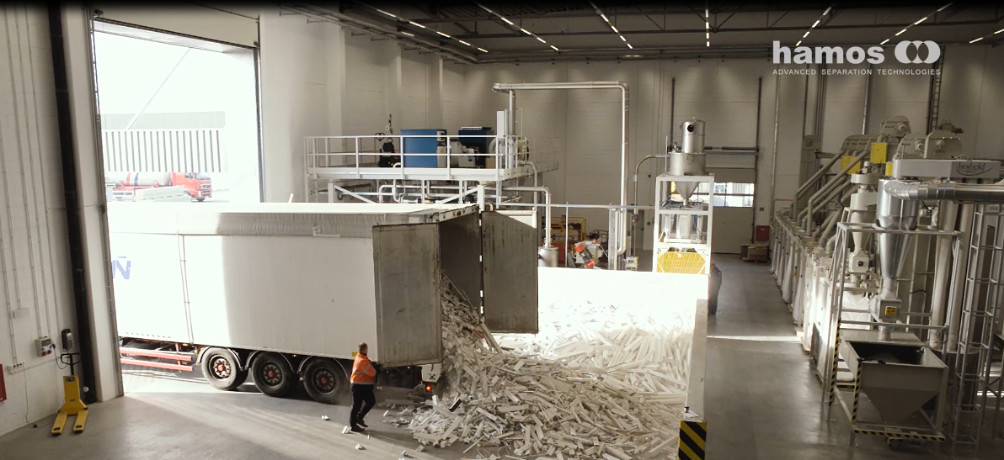
The performance of this concept is demonstrated by REHAU Poland. For more than ten years, the company has operated a hamos WRS recycling plant on an industrial scale. Production waste is consistently processed on site and directly returned to extrusion.
Over the years, substantial quantities of primary raw materials have been saved and significant CO₂ reductions achieved. At the same time, the profitability of production has been sustainably strengthened.
This model clearly demonstrates that circular economy is not a theoretical sustainability concept, but an industrially proven and economically sound production approach.
Recycling as a Competitive Factor
For window profile manufacturers, the question today is no longer whether recycling makes sense, but how consistently it is implemented. The technology is mature, processes are fully automated, purity levels match virgin material standards, and separation costs amount to only a few euros per ton.
Discarding production waste would mean losing valuable raw material and margin.
Those who close their material loops and automatically return production residues to their own manufacturing processes achieve a measurably improved CO₂ balance, reduced disposal costs, higher value creation, greater raw material independence, a credible sustainability strategy.
The closed PVC loop, from production offcut to new window profile, is now both a technical and economic reality. Companies such as REHAU Poland have demonstrated for over a decade how a green, industrial value creation process can be successfully implemented in the window industry.
Author: Selinda Spisla, Head of Marketing, hamos GmbH