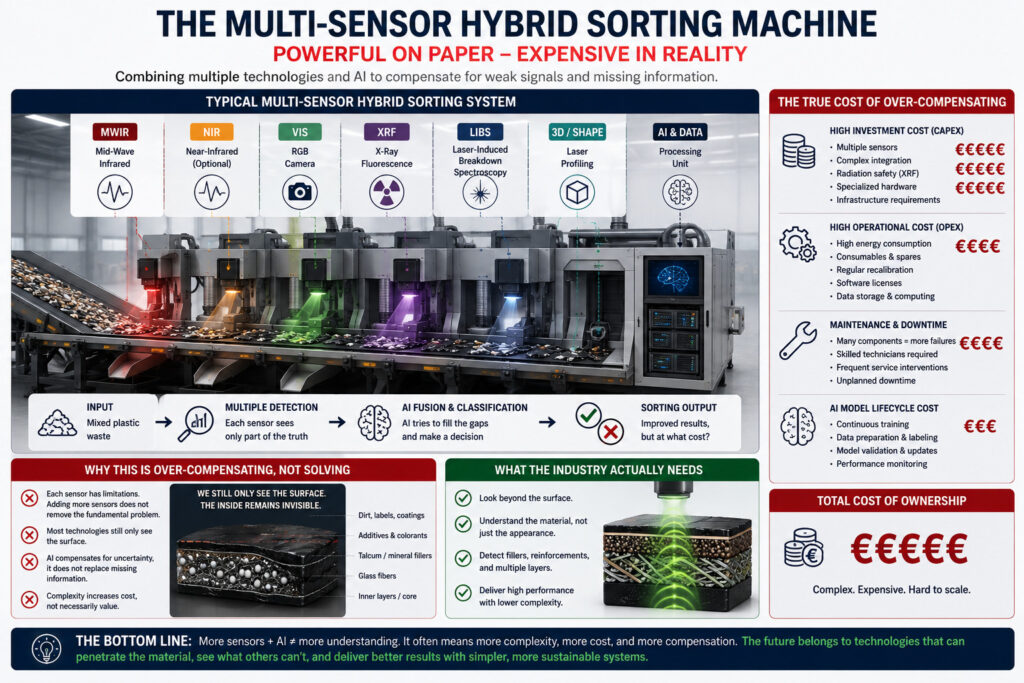
To address this, technology providers have introduced advanced systems combining:
- Mid-wave infrared (MWIR)
- XRF integration
- Deep learning
- AI-assisted classification
- Sensor fusion architectures
These developments represent meaningful engineering progress. But they also expose a deeper industry challenge:
Modern sorting systems increasingly rely on software and compensation architectures because the underlying sensor information remains fundamentally limited.
The key question is no longer simply whether sorting systems can improve performance. The real question is:
Are we truly understanding the material — or are we building increasingly complex systems to compensate for incomplete sensing?
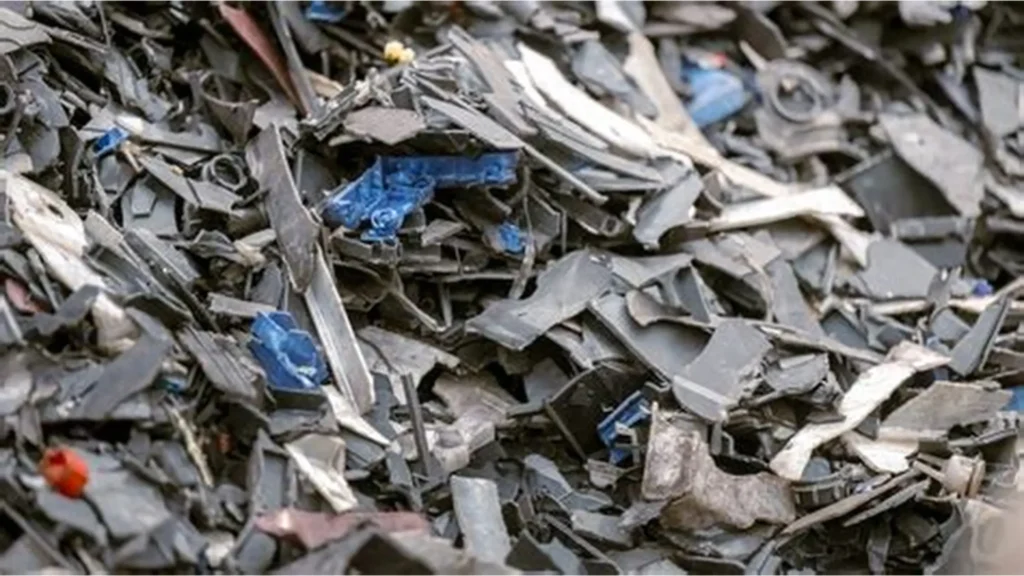
The Black Plastic Challenge
Black plastics have historically been difficult to sort because carbon black pigments absorb most near-infrared light, making materials nearly invisible to conventional NIR systems.
MWIR technology improved detection because carbon black absorption is lower in this frequency range. Recovery rates and polymer differentiation improved significantly.
However, under industrial conditions, important limitations remain.
Real waste streams are rarely clean or homogeneous. Plastics are often:
- Dirty
- Aged
- Coated
- Moisture-affected
- Filled with additives and reinforcements
As a result:
- Spectral signals remain unstable
- Polyolefin spectra can overlap
- Surface contamination affects reliability
- Classification becomes increasingly probabilistic rather than deterministic
Laboratory separability does not automatically translate into robust industrial sorting.
Why AI Is Becoming Essential
This is why artificial intelligence is rapidly becoming central to modern sorting systems.
AI is increasingly used to:
- Interpret weak signals
- Improve classification probabilities
- Compensate for overlapping spectra
- Stabilize sorting decisions under changing waste conditions
This undoubtedly improves performance. But technically, it is important to understand what this means:
AI is not removing the sensing limitation itself. AI is compensating for incomplete or uncertain sensor information.
That distinction matters. The industry is effectively building sophisticated software layers to overcome the limitations of surface-based optical sensing.
AI becomes most powerful when combined with richer physical sensing modalities — not when used primarily to compensate for missing physical information.
In short:
AI can amplify physics, but it cannot replace missing physics.
The Growing Complexity Problem
Modern sorting platforms increasingly combine:
- MWIR
- XRF
- AI
- Deep learning
- Data fusion
These systems are technologically impressive.
But they also become:
- More complex
- More expensive
- More calibration-intensive
- More software-dependent
Continuous retraining, large datasets, and ongoing optimization become operational necessities. This raises an important economic question:
At what point does compensation complexity outweigh the value created?
Surface Detection Remains the Core Limitation
Despite all advancements, one major issue remains unresolved:
Most current systems still primarily analyse the surface of the material.
This becomes increasingly problematic because modern plastics are engineered materials containing:
- Talc
- Glass fibers
- Mineral fillers
- Flame retardants
- Reinforcements
- Multilayer structures
These internal characteristics determine:
- Mechanical behaviour
- Processing properties
- Recycling suitability
- Material value
Yet surface-based systems often cannot reliably identify them. Two plastics may appear nearly identical externally while having completely different internal compositions and recycling pathways. Increasingly, recycling performance depends on volumetric composition rather than surface chemistry alone.
The Next Transition
The next phase of recycling technology will likely move beyond traditional surface spectroscopy. Emerging sensing approaches are beginning to focus on:
- Bulk material characterization
- Internal structure analysis
- Detection of fillers and reinforcements
- Layer-by-layer understanding
- Subsurface material interaction
This represents a major conceptual shift:
From surface recognition toward true material intelligence.
The objective is no longer simply identifying a polymer family.
The objective is understanding the complete material composition.
Conclusion
MWIR, AI-assisted sorting, and hybrid sensor systems represent important progress for the recycling industry. But they also reveal the increasing complexity required to compensate for the limitations of surface-based detection technologies.
As plastics become more engineered and compositionally complex, the industry will increasingly require technologies capable of:
- Seeing beyond the surface
- Understanding internal material composition
- Detecting fillers, layers, and reinforcements directly
- Delivering this at industrial speed and economically viable scale
The future of recycling will not be defined solely by better algorithms. It will be defined by better material understanding.
Because successful circularity depends not just on detecting plastics — but on truly understanding what they are made of.