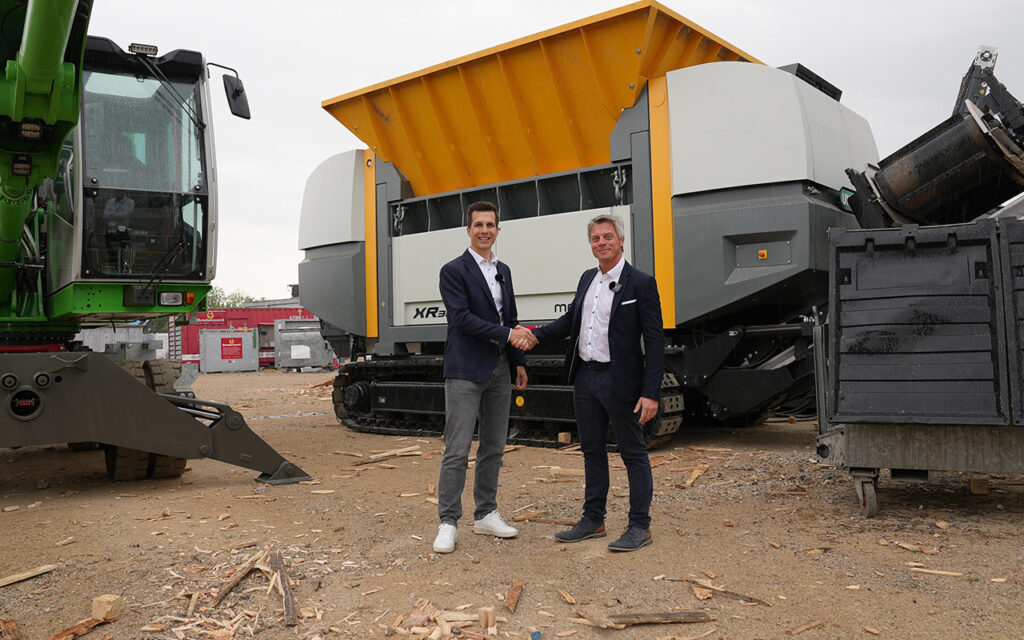


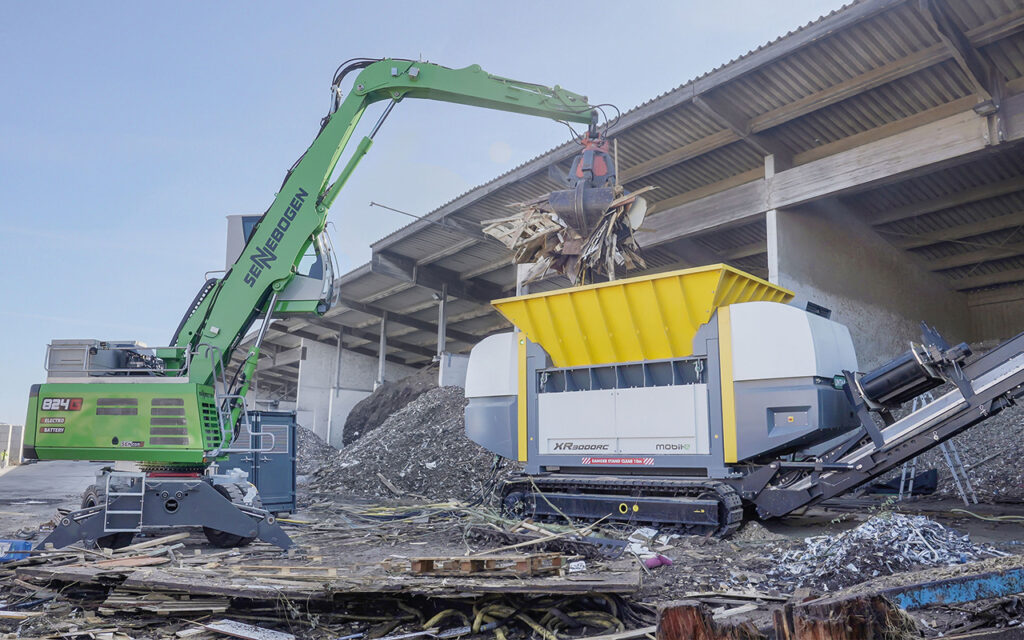
The project launched in early 2026. After just four months of intensive collaboration, the first milestones were achieved and presented to a broad audience for the first time at IFAT Munich. The intelligent networking of material-handling excavators and shredders impressively demonstrates how digitalization and automation can contribute to increased efficiency in the recycling and waste management sectors in the future.
What exactly have UNTHA and SENNEBOGEN developed together?
Sebastian Sennebogen: We have developed an intelligent interface between our 826 G Electro Battery handling excavator and UNTHA’s XR3000 mobil-e shredder. This “Smart Feed Interface” enables communication between the two machines and ensures continuous improvement of the entire process.
What are the benefits of digital communication between the shredder and the excavator?
Stefan Scheiflinger-Ehrenwerth It’s pointless to always run two good machines at maximum capacity. The excavator runs at maximum, the shredder runs at maximum—but in the end, you still don’t get maximum output. You have to listen to the machines. And that’s exactly what we’ve made possible with our project: The shredder tells the excavator—or rather, the excavator operator—when the ideal time is to feed material. The added value is therefore a better cost-benefit ratio: processing more material at a lower cost per ton.
What happens between the two machines?
Stefan Scheiflinger-Ehrenwerth: There are certain parameters that must be observed during feeding to ensure a continuous shredding process. Sensors in the shredder measure how much material is in the cutting chamber and whether the machine is operating at its optimal point. As soon as the optimal condition is reached or no further feeding is required, this information is relayed.
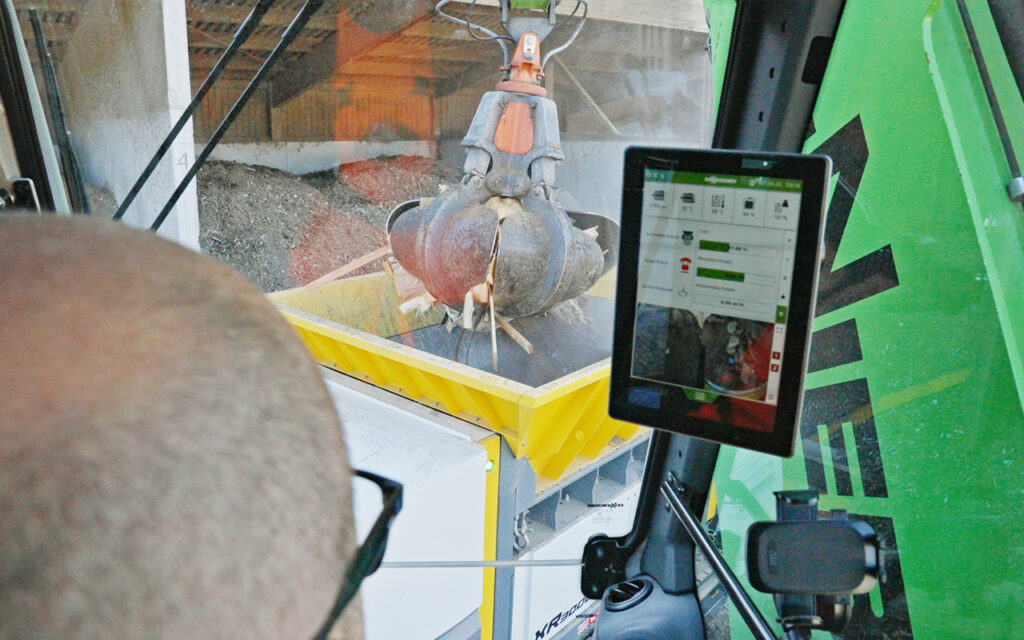
Sebastian Sennebogen: This information then appears on the HMI—the excavator’s display—where we have set up a section for the shredder. The excavator determines the mass per load based on the grapple’s internal weighing function, and the shredder communicates the target-actual comparison using its internal volume flow measurement at the shredder outlet. When the shredder is “full enough,” this is also displayed, and the excavator operator cannot open the grapple over the shredder. This prevents overfeeding.
Stefan Scheiflinger-Ehrenwerth: The excavator operator thus receives all relevant information in real time to feed the shredder optimally. On the one hand, this makes his work easier, and on the other, it improves the result: maximum throughput and efficient machine utilization.
Is there already concrete feedback, for example from test customers? What has the response been so far?
Stefan Scheiflinger-Ehrenwerth: When the Smart Feed Interface and the grapple opening lock were first used at a customer’s site, the excavator operator initially thought there was a technical problem. We then explained to him that the grapple is locked above the shredder when it is not the right time to feed material. He was then able to incorporate this new knowledge into his work and was pleasantly surprised by how it affected the shredding process.
Sebastian Sennebogen: We also illustrated the whole process with simple symbols on the display. And on top of that, the excavator operator can still reposition and prepare the material next to the shredder. The grapple is only locked in a defined area above the shredder. This means work can still be done in the meantime.
How did this joint project come about; what was the initial spark?
Sebastian Sennebogen: A mutual development partner initiated it. He approached us and suggested we collaborate to generate a benefit for our customers. We also know that many of our customers work with UNTHA and vice versa, so it made sense to tackle such a project together.
Stefan Scheiflinger-Ehrenwerth: We share a similar philosophy, namely “differentiation through innovation.”That was a good foundation for our collaboration on this project. And after that, everything moved very quickly—our development teams achieved a truly great result in just four months, and the Smart Feed Interface is now already included in our price lists, so it can be added to all new purchases. You can’t bring a project like this to market any faster.
What outlook for the future can you provide for this area?
Sebastian Sennebogen: On the machine side, operations are increasingly moving toward semi-autonomous and autonomous processes. In the near future, the peripherals surrounding our handling excavator and the shredder will optimize each other from the start of the process to the end, ensuring the most continuous output and the best possible daily throughput for the customer.
Stefan Scheiflinger-Ehrenwerth: When it comes to autonomy, there’s also the fact that customers want to use machines in an even more flexible way, regardless of location. That’s why we developed the UNTHA Power Core. It allows our shredders to be used even in places where there’s no power supply and can also operate SENNEBOGEN excavators. This trio—excavator, shredder, Power Core—can be seen as the smallest possible system and would be ready for use anywhere in the world, even without the appropriate infrastructure.
Key Facts
- Joint development project by UNTHA and SENNEBOGEN
- Only four months from project start to market readiness
- Greater efficiency, lower costs, and easier operation
- Smart Feed Interface: for all SENNEBOGEN G-Series models equipped with the latest-generation SENCON control system and all UNTHA XR-Class shredders of the latest generation