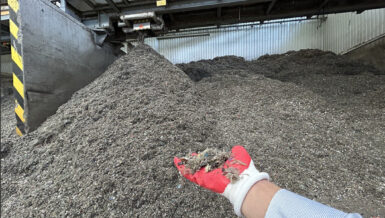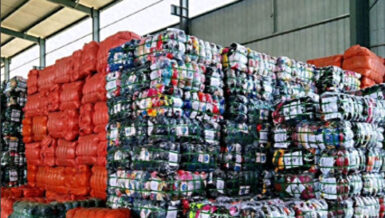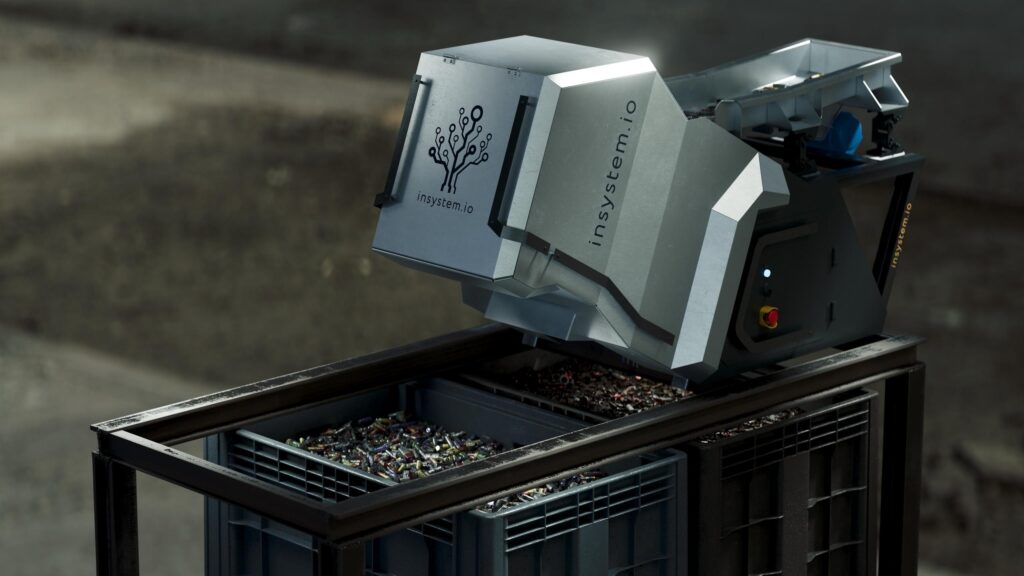
Each of those batteries arrives at a recycling plant, where after multiple sorting steps they end up in the magnetic ferrous fraction mixed with other metals. It creates a problem where batteries hidden in MSW streams are difficult to separate at scale therefore resulting in lost value and contamination.
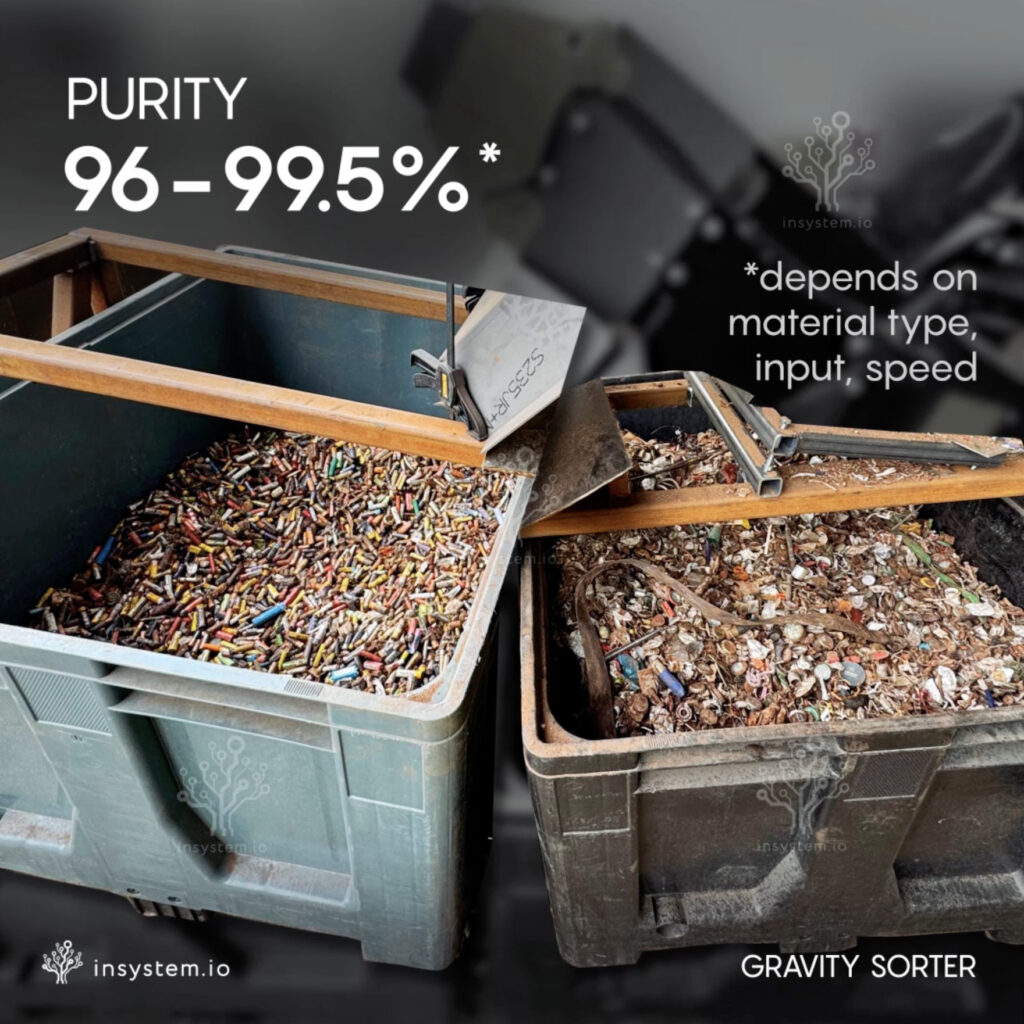
That’s why inSystem.io has developed a new Gravity Sorter, free-fall optical unit for the 5 to 70 mm fraction, achieving 96%+ purity during the facility runs.
The Problem
The 5 to 70 mm range is where most sorting equipment loses accuracy because the material is small, heavy, irregularly shaped, and aerodynamically difficult. Most of it ends up in landfill or RDF with recoverable value still inside. For MSW battery streams, the only available approach has been hand-picking, which brings safety, accuracy, and labor costs while batteries that escape contaminate the ferrous scrap output or cause fires downstream.
The Solution
The Gravity Sorter removes mixed batteries in a single pass, producing a clean battery containing fraction. It achieved 96%+ purity at throughput of up to 6 tons per hour across mixed batteries, e-waste fragments, IBA, non-ferrous metal scrap, plastics, and aggregates.
The unit is designed to integrate into existing lines without major redesign. Operators control the Gravity Sorter through the inSystem’s Cloud Platform: they configure fractions, adjust ejection per material class, monitor in real time, label new images for AI retraining, and deploy retrained models in-house at no extra cost.

Technical Details
The Gravity Sorter is built around continuous trajectory tracking. Up to 400 fps AI-detection follows each object across multiple frames each second during the fall, predicting its individual trajectory in real time. High-pressure air nozzles fire at the precisely calculated ejection point within 0.25 milliseconds, which is what allows the unit to handle heavy, irregularly shaped objects that conventional sorting misses.
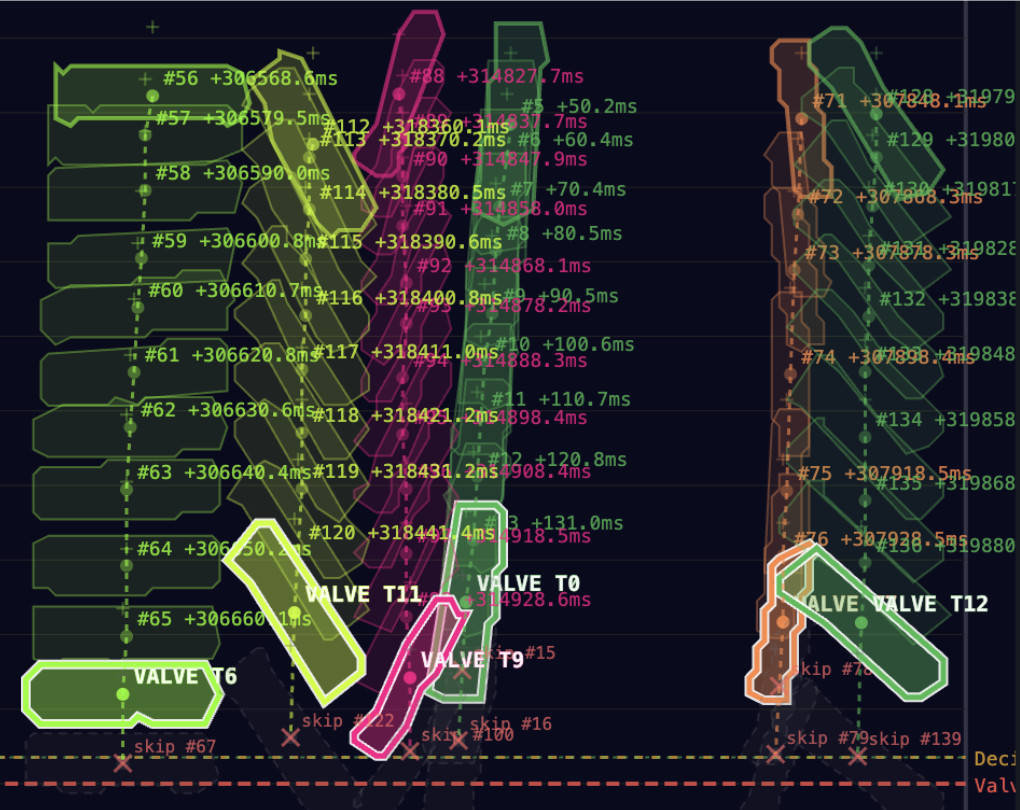
The AI based system can understand properties such as (text, features, color etc of each object). It
is upgradable to NIR, SWIR, and LWIR spectra to identify additional features such as plastic
polymers including PET, HDPE, and PP.
The system includes a feeder, Working widths are configurable on request. The unit operates at
free-fall speeds of 1.5 to 4 meters per second.
Materials handled include mixed batteries (lithium-ion, alkaline, NiMH, NiCd, button cells), e-waste
and WEEE fragments, plastic flakes (PET, HDPE, PP), incinerator bottom ash containing
recoverable copper, aluminum, stainless steel and brass, non-ferrous metal scrap, and C&D
aggregate fines. The unit is suitable for retrofit into existing sorting lines as well as integration into
new line designs.
From the Team
“We built the Gravity Sorter for the fractions that have historically been difficult to sort at scale, ” said Evgeny Gudov, CEO of inSystem B.V. “Through developing a new approach, we eliminated the belt and delay-based ejection. The unit works in free fall, and the AI camera tracks each object individually with its speed, acceleration, rotation during the fall to time the ejection precisely. That saves energy and improves accuracy.
Why spend energy accelerating an object to 3 m/s on a conveyor if it is going to hit a wall anyway? If you simply drop it from the height of an ordinary chair, gravity will accelerate it to the same speed. The same logic applies to the air. The nozzles open only at the calculated ejection moment and only according to the shape of the object. With up to 500 on/off cycles per second, no air is wasted on the gaps between objects. That alone saves a lot of compressed air compared to older systems. In some cases, the energy savings are enough to pay for the unit on their own.”
The Gravity Sorter sparked significant interest at IFAT Munich 2026 last week. Over 100 conversations at the inSystem’s booth came from plant directors and line engineers across Europe, Canada, Australia, and Latin America, and more than 15 recycling facilities requested test runs covering battery pre-sort from MSW ferrous, separation of non-ferrous metals, and mixed E-Waste sorting.
Pilot Evaluations and Next Steps
inSystem.io is now accepting pilot requests and first orders for the Gravity Sorter. Companies can send an input mix for evaluation. Each unit ships with a feeder and a custom-trained AI model. To request a test, technical specifications, or integration details, visit https://www.insystem.io/ or contact go@insystem.io.
About inSystem.io
inSystem.io is a Dutch recycling automation company that acts as an innovation partner for recycling facilities, helping improve efficiency and reduce labor costs. With experience across AI, robotics, and recycling, it develops solutions that are easy to integrate and maintain.