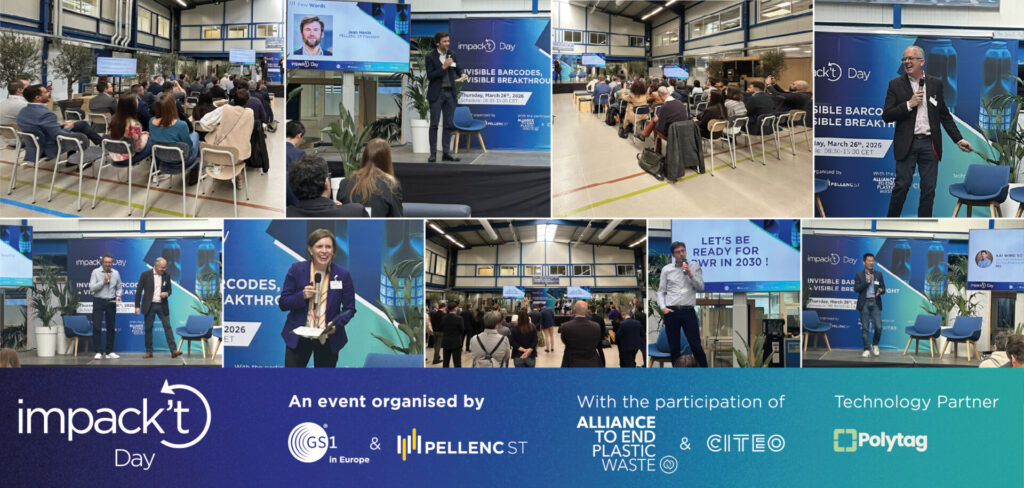
Co-organized by GS1 in Europe and Pellenc ST, with the participation of Citeo and Alliance to End Plastic Waste, and featuring Polytag as technology partner, the event brought together around 60 stakeholders from across the waste and recycling value chain, including representatives from operators, industry experts, PROs, institutions, brand owners and retailers.
The day focused on the emergence of invisible barcodes technologies applied to the traceability and industrial sorting of household packaging waste. By enabling more precise identification and separation of materials, these technologies open new recycling routes improving circularity for flexible packaging and selected rigid applications.
“Invisible barcodes represent a breakthrough in how we can track and sort packaging at scale. But innovation alone is not enough—collaboration and standardization will be the real enablers of circularity,” added Florent Gras, Plastic Segment Director at Pellenc ST.
A key theme throughout the discussion was the importance of open standards to ensure scalability, interoperability, and industry-wide adoption.
“For these technologies to deliver their full potential, we need alignment across the value chain. Open and interoperable standards are essential to ensure that sorting systems, packaging design, and recycling infrastructures can work seamlessly together,” said Stéphane Cren, Head of Innovation at GS1 France.
Throughout the day, participants had the opportunity to:
- Experience live demonstrations of technology under industrial waste sorting conditions,
- Gain a comprehensive overview of the current state of the art, from both technical and operational perspectives,
- Explore new recycling pathways enabled by granular sorting for both rigid and flexible packaging,
- Participate in a collaborative workshop with experts and industry leaders to identify and prioritize potential applications for household packaging.
“We believe invisible barcodes can become a foundational layer of the circular economy—connecting packaging, sorting, and recycling through data. This Impact’t event is a pivotal moment working with Industry leaders” said Will Addy, COO at Polytag.
The workshop sessions further emphasized the need for shared frameworks and open approaches to consider development across markets.
“The industry is moving from R&D to pilots. Recycling capacity and recyclate incorporation needs to drastically increase to meet tomorrow’s requirements, reasons why Citeo supports and invests in R&D projects to improve collection, sorting and recycling for household packaging” said Laurent Bastida, Director of Studies and Experimentation at Citeo.
“Flexible plastics are essential to modern life and are also hard to recycle. We have taken a market-driven approach, ensuring recycled materials meet end-markets first. It requires coordinated action, and we convene stakeholders across the value chain to drive alignment and advance circularity for flexible plastics” added Franz van Rijckevorsel, Senior Advisor at Alliance to End Plastic Waste.
This event highlighted the collective ambition of stakeholders to accelerate innovation through collaboration, drive the adoption of open standards, and advance the transition toward a truly circular economy for packaging.