





In industrial sorting, food inspection or material research, acquiring an image is only the beginning. The more difficult questions are what the image reveals about a material, whether the measurement can be reproduced and how the result can be used in practice. Hyperspectral imaging adds spectral information to spatial images, making it possible to examine material-related differences that may not be apparent from visible characteristics alone. Turning those measurements into dependable information, however, requires more than a camera.
HAIP Solutions GmbH, based in Hannover, Germany, develops and manufactures hyperspectral imaging technology with the complete application in mind. The company’s roots go back to development work in 2018. What began with four founders has developed into a multidisciplinary team of 16 people in 2026, working across hardware and software engineering, optics, production, application support and customer-facing roles. The guiding idea has remained consistent: hyperspectral imaging should be easier to understand, integrate and use, whether in a research laboratory or an industrial process.
It’s not just a hyperspectral camera
Reliable hyperspectral data acquisition depends on the interaction of camera, illumination, acquisition geometry, motion and processing software. The choice of spectral range must suit the material, illumination must deliver appropriate intensity and uniformity and the data must be captured and interpreted in a way that fits the application. HAIP Solutions therefore develops its technology as a connected system rather than treating each component as an isolated product.
Its portfolio includes cameras for visible and near-infrared (VNIR), near-infrared (NIR) and short-wave infrared (SWIR) imaging, as well as a dedicated muliti-line RGB camera for combined use with the hyperspectral cameras. The BlackIndustry series addresses industrial line-scan inspection, while systems such as the BlackBird V2, BlackBullet V2 and BlackMobile V2 serve airborne, laboratory and mobile measurement tasks. Spectrally matched BlackBright illumination, including SWIR and VNIR solutions, provides the lighting required for consistent acquisition under different conditions.
Software connects these components to the work that follows. BlackStudio supports camera control, acquisition, visualisation, spectral analysis and classifier development. On compatible BlackIndustry cameras, trained models can be deployed for classification directly on the camera’s processing hardware, helping to limit the need to transfer and process complete hyperspectral data volumes elsewhere. BlackFusion adds a further option: Sensor Fusion by digital calibration and spatial alignment of BlackIndustry RGB and SWIR cameras, allowing corresponding colour and spectral data to be acquired within a coordinated workflow.
Designed to be usable from the outset
For HAIP Solutions, usability is not simply a matter of interface design. It influences the entire system, from mounting and configuration to software access and integration with external equipment. Established machine-vision interfaces, including GenICam and dedicated C++ and Python tools, help system integrators work with the technology in existing environments.
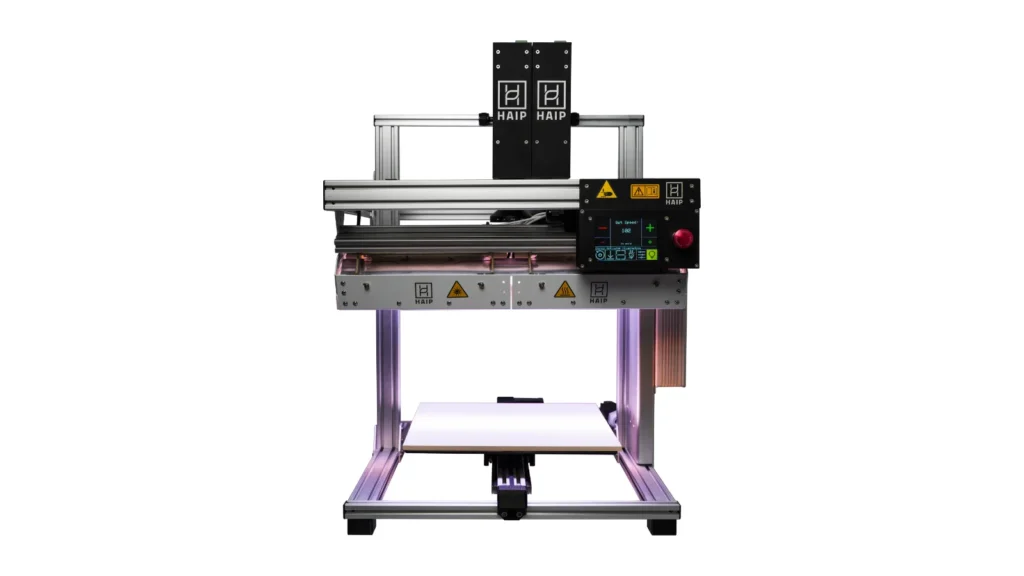
The BlackIndustry Station demonstrates the same principle in a ready-to-use format. It brings camera mounting, integrated illumination and controlled sample movement into one compact scanning system. Researchers and industrial teams can use it for feasibility measurements, material evaluation, model development and at-line inspection without first constructing a complete test setup. The purpose is to lower the effort needed to establish controlled measurement conditions, not to remove the need for application-specific validation.
Applications determine the solution
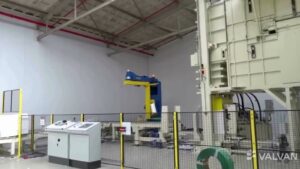
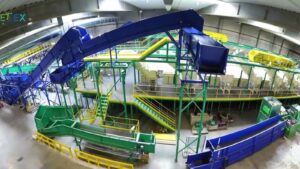
HAIP Solutions works across industry and research, with a growing emphasis on automated sorting and inspection. In recycling, hyperspectral measurements can help distinguish polymer types and other material fractions according to their spectral behaviour, supporting the development of material-based sorting strategies. In food processing, spectral data can contribute to the investigation of foreign materials and composition-related properties, alongside visible quality criteria. Whether an application is feasible depends on the material, sensing configuration and operating conditions, which is why testing remains central to the company’s approach.
The same measurement principles support scientific work in agriculture, plant phenotyping, environmental monitoring, geology and materials research. Airborne imaging can help researchers investigate vegetation properties and spatial variations, while laboratory and mobile systems allow spectral examination in other contexts. Rather than presenting one hyperspectral camera as a universal answer, HAIP Solutions selects the approach around the information the user needs.
Professional services and direct customer contact
The relationship with customers is an integral part of the technology offering. HAIP Solutions works directly with researchers, machine builders, system integrators and industrial users to identify suitable acquisition conditions before a system is implemented. Its professional services include feasibility measurements, application-specific consultation, integration assistance, technical support and individual training, including on-site sessions.
This close exchange helps customers progress from an initial technical question to a workable setup, while giving the development team practical feedback. The objective is to make customers capable of working confidently with their own processes.
Research as a route to practical innovation
Collaborative research provides another link between the company’s technical development and emerging application requirements. HAIP Solutions is involved in projects investigating subjects such as the identification of difficult technical plastics in electronic waste (HypReSort), hyperspectral monitoring in selective laser ablation processes (HyperFoil), and the early detection of plant stress and pest-related symptoms (EMSig and DHYNAMite). These projects explore technological possibilities under application-relevant conditions.
Research partnerships help the company challenge its designs, develop new sensing and processing approaches and learn where system integration matters most. This knowledge feeds back into product development and the professional support provided to customers.
From acquisition to certainty
As hyperspectral imaging becomes more relevant to industrial machine vision, its usefulness will increasingly be measured by the reliability and accessibility of the complete workflow. A system must produce reproducible data, fit within practical speed and integration constraints and deliver information that can support a research finding or a process decision. HAIP Solutions aims to close the gap between advanced spectral sensing and everyday use through the combination of application-oriented hardware, dedicated software and direct technical support.
The company’s ambition is not simply to generate more spectral data. It is to make the technology sufficiently straightforward and the results sufficiently dependable that customers can use them with confidence. That is the idea behind its guiding line: ‘From acquisition to certainty.’