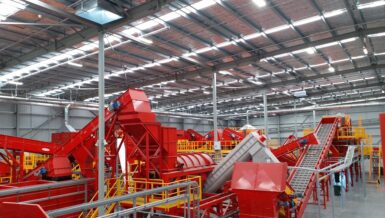
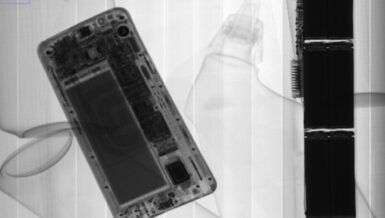
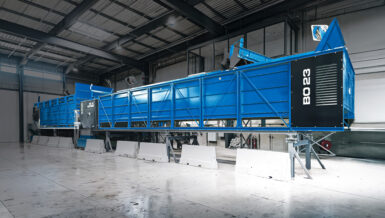
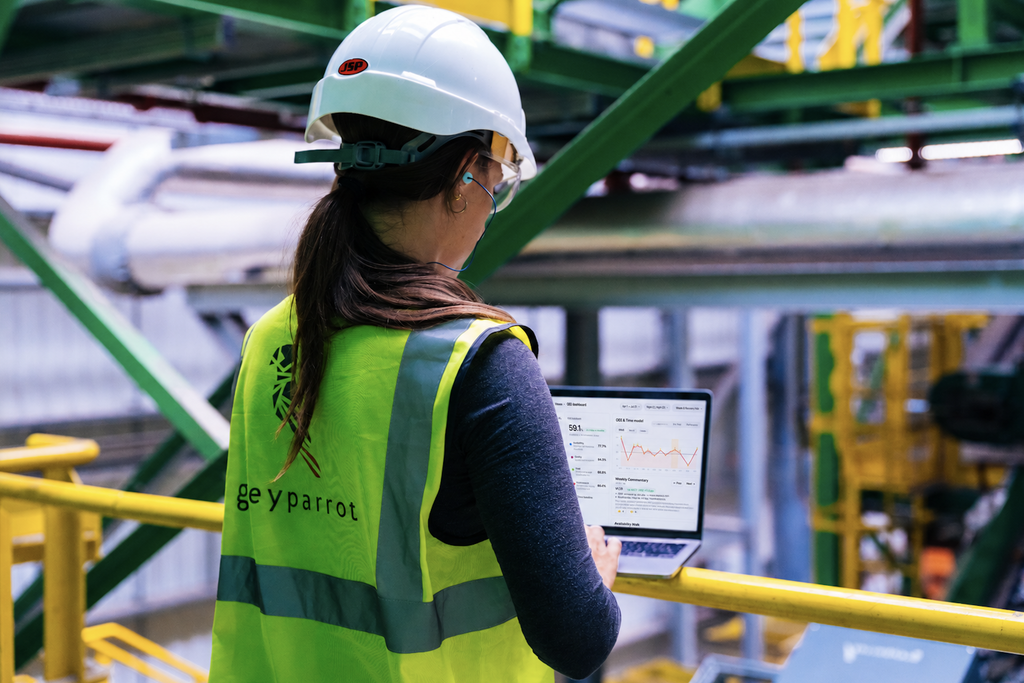
Greyparrot, the AI waste intelligence company, today launched its OEE dashboard, patent pending, for materials recovery facilities (MRFs) and plastics recovery facilities (PRFs). Available initially to select Greyparrot Analyzer customers who have site-wide installation of the AI-camera system, it is a step-change in how operators track Overall Equipment Effectiveness.
Manufacturing has measured OEE for decades, standardised under ISO 22400-2. Recovery facilities measure it too, but after the fact – assembled in spreadsheets from weighbridge tickets, downtime logs and periodic bale audits, pulled from separate systems after the shift by different departments.
Within this measure, the quality metric is the weakest link: Quality is good output divided by total output, and until now that equation could not be closed live. It takes a continuous mass balance of the site – what arrives at the infeed, what leaves in every outfeed, and where material is lost in between. Manual sampling covers less than 1% of material. Typically, manual logs reported OEE 8 to 15 points higher than the true figure.
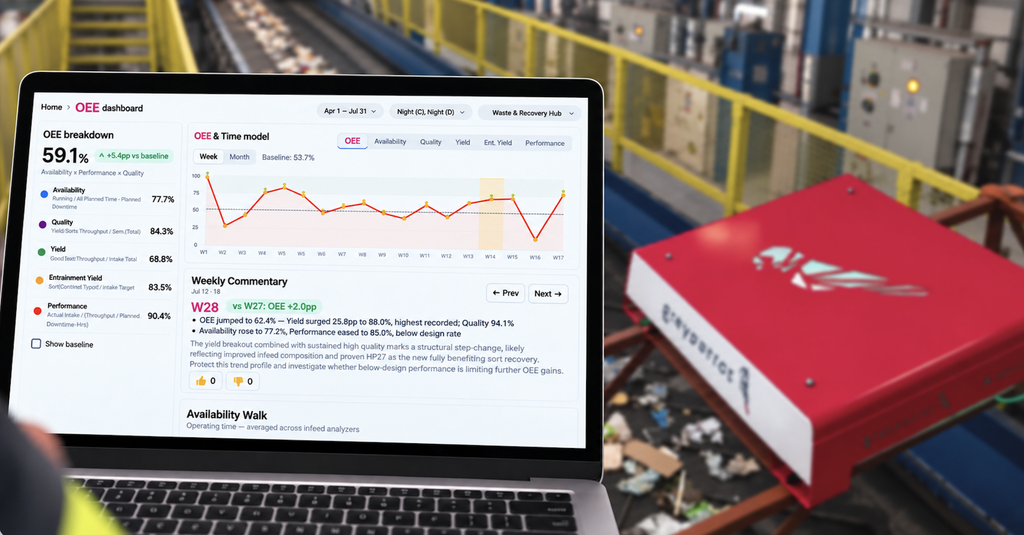
OEE is the product of three metrics: availability × performance × quality. The Greyparrot OEE dashboard scores all three shift by shift, across the facility, from live composition data:
- Availability – uptime against scheduled production time, surfacing unplanned downtime, jams and “black belt” periods when the line runs empty
- Performance – actual throughput against design capacity, exposing bottleneck stages and shift-based tonnage variance
- Quality – contamination and purity swings on every output stream, protecting bale quality, offtake prices and customer contracts
Every movement in the score breaks down into plain language: which loss, on which line, on which shift, what it costs, and what to do next. The OEE score updates continuously and alerts the moment a component falls outside its expected range. Operators can see performance benchmarked across shifts, lines and sites to get a quick snapshot of what needs fixing, who needs to act, and the value of doing it – while the shift is still running.
“Recovery facilities are industrial plants, competing with virgin production of materials. For the past seven years, we’ve listened closely to our customers and built from understanding what is happening on a single belt to seeing how an entire facility is performing. Live OEE tracking brings recovery plants the same level of precision, immediacy and operational efficiency as any modern factory.” – Mikela Druckman, Co-founder and CEO, Greyparrot
“Our teams have never been short of operational expertise. What continuous data changes is how quickly that expertise can be pointed at the right problem – we can act on the actual cause of a loss on the same shift, rather than reconstructing it from different sources of information. The Greyparrot OEE dashboard will better align our team with a single source of truth.” – Ian McSpirit, Operational Support Manager – Recycling, Biffa
With more than 300 Analyzers deployed across 20+ countries, facilities using Greyparrot’s real-time data have reported gains of 10% to 30%, with one site saving more than £1.5 million in a single year. Because availability, performance and quality are independent of commodity price swings, improvement can be attributed to the operation rather than to a favourable market.
The OEE dashboard launches at RWM 2026, the Resource & Waste Management Expo, held at the NEC Birmingham on 16-17 September. Greyparrot will be running live OEE tracking from an operating facility on stand RS-D192, where visitors can run a simulator to see it in action in a working plant scored in real time.
About Greyparrot
Greyparrot (greyparrot.ai) is a leader in AI waste intelligence, named to TIME’s Best Inventions 2025. Its Analyzer units operate in recovery facilities across more than 20 countries and have passed one trillion waste detections. Waste and recycling companies including WM, Circular Services, Veolia, Biffa and FCC Environment use Greyparrot technology to improve recovery rates, monitor material quality and run more profitable facilities.