





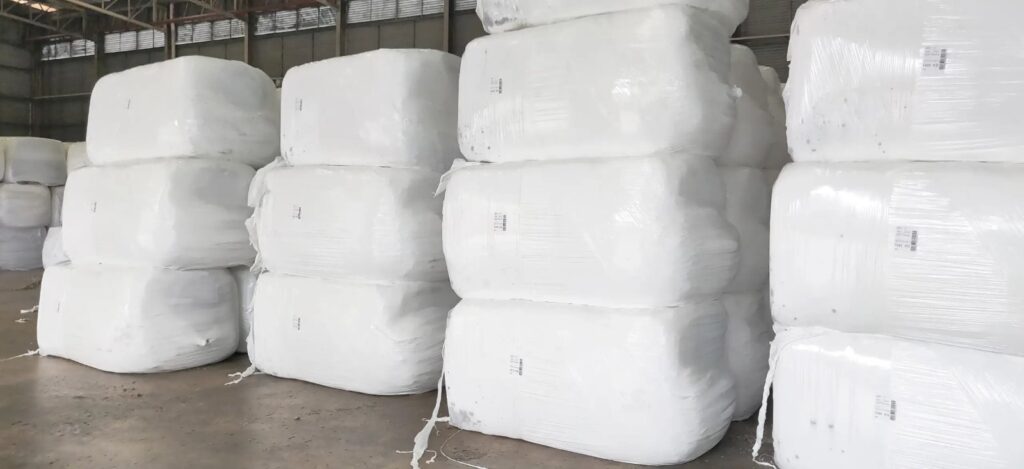
Ask an RDF producer about baling and wrapping and the conversation usually turns to cost per bale: film, labor, cycle time. Those numbers matter, but they are not where the money is made. In the refuse-derived fuel chain, revenue comes from tons that reach the buyer in usable condition and on schedule. Everything that happens to the bale on the way there either protects that revenue or erodes it.
A chain with three critical links
Most RDF passes through three hands before it becomes energy.
1. A producer collects and sorts waste, strips out what can be recycled or won’t burn cleanly, and processes what remains into RDF. Baling and wrapping is made by producer,
2. or an operator who receives RDF material wrapped or receives material and bales and wraps it, and manages everything between production and shipment – storage, quality control, terminal handling, documentation, and transport by road or water.
3. Finally, a receiving plant, often a waste-to-energy facility, takes the material and converts it into electricity, heat, or both.
Each link relies on the previous one handing over material that is still fit for purpose. And because RDF often waits for a ship, a truck or free capacity at the plant, the time between baling and burning can be longer than expected.
Where the real risk sits
The instinct is to treat baling and wrapping as a cost line. In practice, it’s a value-protection step.
“Unwrapped or poorly protected RDF is exposed to moisture, contamination, and physical damage, and all these lower its quality, and in some cases its usability, by the time it reaches the plant that’s paying for it.
“The sharper way to put it: the biggest risk in the RDF chain isn’t what it costs to bale material. It’s the possibility that material doesn’t make it to market in the condition it needs to,” says Ville-Pekka Parkkinen, Cross Wrap’s Sales Director.

What this means for bale handling and storage
For recyclers and RDF producers, the chain is not an abstract idea. It shows up every day in the yard. A few practical points make a measurable difference:
Plan the yard for waiting time, not just throughput. RDF rarely leaves the day it is baled. Size storage for the longest realistic wait for transport or receiving capacity, and remember that bale shape changes how much space that takes. In our calculation, 1,000 tons of square bales need roughly 1,450 m³ of storage space, while the same tonnage in round bales needs about 2,600 m³ once the gaps between bales are counted.
Count the lifts. A bale is typically moved several times: off the wrapper, into the stack, onto the truck, off at the terminal and again at the plant. With square bales of about 1,000 kg, 1,000 tons means about 1,000 bales. With round bales of about 600 kg, it means around 1,670 bales. That is roughly 40% fewer forklift moves for the same tonnage.
Protect the bales. Cross-wrapping seals a square bale in stretch film on all six sides. Most wrapping methods turn the bale, but here it stays still the whole time, so less material ends up as litter. This method puts more film on the corners, which take the most stress in handling, transport and storage, and less on the flat sides. The result is a strong, fully sealed bale that uses just the right amount of film.
Because no moisture or oxygen gets in, a cross-wrapped bale stays in good condition. It doesn’t shed litter or give off odors, so it’s clean and easy to ship by truck, train or ship.
Stack for stability and safety. Flat-sided square bales build higher, steadier stacks that do not roll or shift. Follow local fire safety rules on stack size and spacing.
Label your bales by production date, material and weight, and ship the oldest first. Even well-wrapped material should not sit longer than it needs to.
Round bales tend to fill a 40 ft container by volume at around 16.8 tons, leaving payload unused. Square bales can fill it up to its weight limit of 26–28 tons, which means about 35–40% fewer transports per 1,000 tons.
Cross Wrap’s role: protecting the value, not just the bale
Cross Wrap sits at the critical point in this chain, between production and transport, where RDF is baled and wrapped into a unified, protected, handleable unit before storage and transport. That’s where the value of the fuel is either preserved or put at risk.
What that protection actually delivers:
- Fuel value protection. Wrapping reduces the quality and material loss risk that comes from moisture, unraveling, contamination, and bale damage.
- Export-readiness. An intact, protected bale is easier to handle at terminals, ports, and the receiving facility.
- Controlled storability. Protected RDF can be stored with confidence while it waits for transport, rather than degrading in the yard. Square bales fit about 80% more waste into the same space.
- Logistics efficiency. A dense, uniform bale makes better use of space and simplifies handling and material flow. At about 1,000 kg versus 600 kg for a round bale, square bales need 35–40% fewer transports per 1,000 ton.
- Delivery reliability. Consistent baling and wrapping lowers the risk that material fails to meet agreed handling or delivery requirements.
“Cross Wrap doesn’t just sell a wrapping machine. It helps protect the commercial value of the fuel, and makes sure the material flow can be stored, transported, and delivered to the customer reliably,” summarizes Ville-Pekka Parkkinen.
Cross Wrap helps RDF producers, exporters and receiving plants turn a waste flow into a cash flow, reliably. Wrapping (Bale Wrapper) keeps every ton intact on its way to the buyer. Our Bale Openers (Bale Opener) then open the bales at the waste-to-energy plant, so the material arrives ready for use. Every ton that reaches its buyer intact and goes smoothly into the process is what we target in this chain.
The bottom line
Cost per bale is easy to measure. Cost per ton delivered is what decides the margin. Producers and operators who look at the whole route, from the baler to the moment the bale is opened at the plant, have more control over both the value of their fuel and the cost of getting it there. Every ton that arrives intact is a ton that earns, and protecting it is the real job of baling and wrapping in the RDF chain.