


All articles in this market
Textile recycling — page 1 of 3





Promoted videos
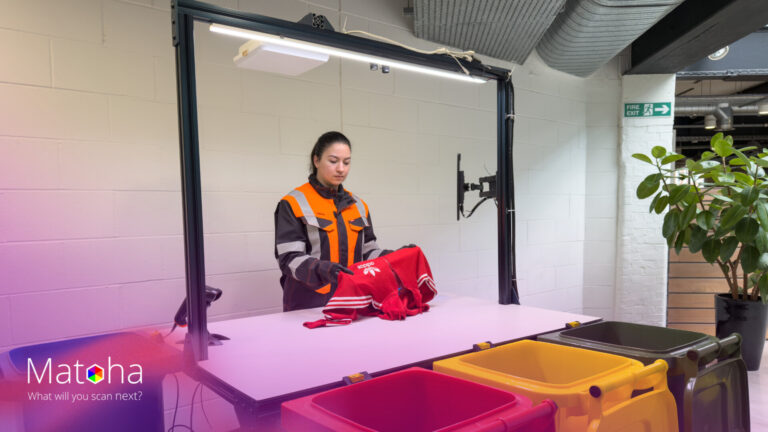
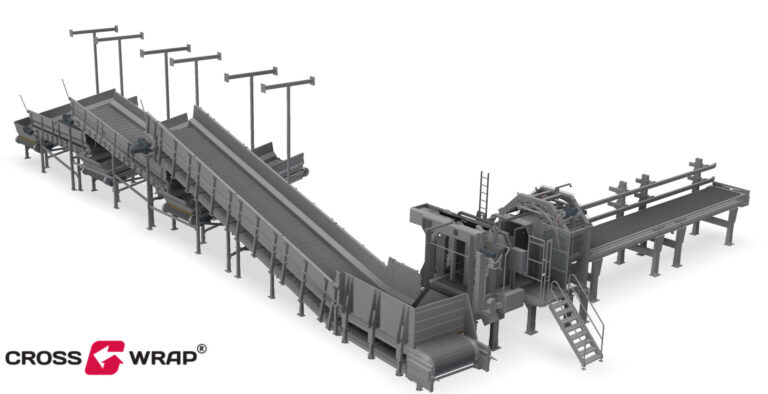
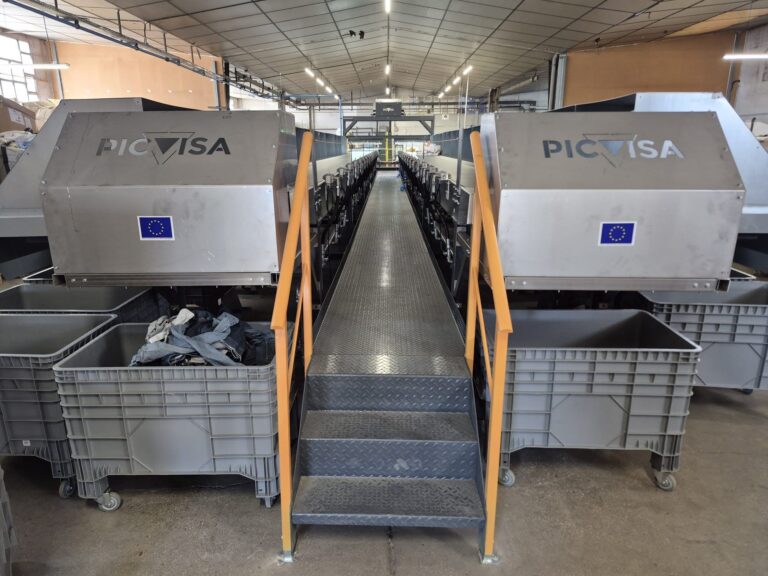
Textile recycling in action
Ask the Expert
Ask a textile recycling expert — free
Engineers and product specialists who answer technical questions from readers. The answer comes back to you by e-mail; when we publish it, other readers benefit too.
 Ivan Hondekyn
Valvan nv
Ivan Hondekyn
Valvan nv
Ivan Hondekyn has been part of the Valvan team for over 25 years, bringing a rare depth of expertise across design, project…
Ask a question Dan Fairest
M&J Recycling
Dan Fairest
M&J Recycling
At M&J Recycling, my role as the UK & ROI Sales Manager centres on providing top-tier shredding solutions tailored to the waste…
Ask a question Laetitia Paveau
Pellenc ST
Laetitia Paveau
Pellenc ST
Laetitia is the Marketing and Communications Director at Pellenc ST. An engineer by training, she has spent over 20 years driving innovation…
Ask a question Tom Jansen
TOMRA Recycling
Tom Jansen
TOMRA Recycling
With more than 20 years of experience in sensor-based sorting technologies, Tom Jansen is VP, Head of Segments at TOMRA Recycling, where…
Ask a questionMarket & Technology Focus
Textile recycling, in depth in your inbox
Every Thursday edition takes one market or technology in depth. These are the editions on this market — read them online or get the next one by e-mail.
Subscribe to our E-newsletters
Recycling technology worth your time: new equipment, plant case studies and the numbers behind them. Free, twice a week.
Questions and answers
Frequently asked about textile recycling
What happens to a garment once it enters the textile recycling stream?
It's first sorted by hand or with automated near-infrared (NIR) sorters into fiber type, color, and condition, since that determines whether it's reusable, mechanically shreddable, or suitable for chemical recycling. Wearable items are typically diverted to resale, while the rest is fed through a shredding or garnetting line that tears the fabric back into loose fiber, or in newer systems, dissolved chemically to separate blended polymers.
Why can't textile waste just go through a standard materials recovery facility?
Garments are rarely a single, pure material — a typical piece can blend cotton, polyester, and elastane, and carry zippers, buttons, rivets, and printed or coated finishes that a standard MRF's optical sorters aren't tuned to separate. That mix has to be identified and sorted by fiber composition before any mechanical or chemical process can run efficiently, which is why textiles need dedicated recycling infrastructure rather than commingled recycling lines.
What materials are actually recovered from used textiles?
Natural fibers like cotton and wool can be mechanically pulled apart into staple fiber for spinning into new yarn or nonwoven products, while synthetics such as polyester and nylon can be mechanically reprocessed or, increasingly, chemically depolymerized back into base monomers for virgin-quality fiber. Hardware like metal zippers, buttons, and rivets is screened out early and sent to scrap metal recovery.
What equipment is used to process textile waste at scale?
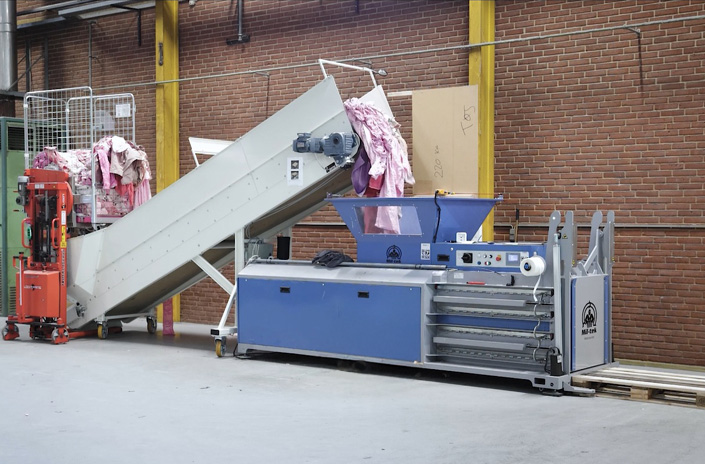
Shredders and garnett machines tear fabric into loose fiber, while cutting and opening equipment removes seams, labels, and trims before shredding to reduce contamination. Balers compact sorted fiber for transport, and in chemical recycling facilities, dissolution and depolymerization reactors break synthetic polymers down into reusable feedstock.
What regulations or standards apply to textile recycling?
The EU Waste Framework Directive now requires member states to collect textile waste separately, a mandate that took effect in January 2025 and is driving a sharp rise in collection volumes across Europe. Extended producer responsibility (EPR) schemes are also expanding in the EU and parts of the US, shifting collection and recycling costs onto apparel brands and creating stronger incentives for design-for-recyclability.
What are the environmental and economic benefits of recycling textiles properly?
Recycled fiber avoids the substantial water, energy, and pesticide inputs required to grow virgin cotton or produce virgin polyester from petrochemicals, and diverting textiles from landfill reduces methane generation from decomposing natural fibers. Economically, recovered fiber supplies lower-cost feedstock to spinners and nonwoven manufacturers at a time when virgin fiber prices are volatile.
Can all types of textiles be recycled the same way?
No — blended fabrics are the hardest to recycle because mechanical shredding shortens and weakens fiber regardless of composition, and most chemical recycling processes are still designed around a single polymer, so cotton-polyester blends often can't be fully separated. Dyes, coatings, flame retardants, and non-textile trim like zippers and buttons further limit which items qualify for high-value recycling versus downcycling.
What's the difference between downcycling and fiber-to-fiber recycling?
Downcycling mechanically shreds textiles into shorter, weaker fibers used for insulation batting, wiping rags, or acoustic padding — products that don't require the fiber strength needed for spinning new yarn. True fiber-to-fiber recycling, by contrast, aims to recover fiber of near-virgin quality, either through careful mechanical processing of single-material garments or through chemical depolymerization that rebuilds the polymer from scratch.
Does it matter whether textile waste comes from consumers or from manufacturing?
Yes — pre-consumer or industrial textile waste, such as fabric offcuts from garment factories, is typically a single known fiber type, unworn, and free of contaminants, making it far easier and cheaper to recycle at high quality. Post-consumer clothing is far more variable in fiber blend, condition, and contamination from wear, washing, and mixed trims, which is why it usually requires more intensive sorting and yields lower-grade output.
What trends are shaping the future of textile recycling?
Chemical recycling technologies that depolymerize polyester and cellulosic fibers back into virgin-equivalent feedstock are scaling up to address the blended-fiber problem that mechanical recycling can't solve. At the same time, automated NIR fiber-identification sorting and new EPR and mandatory-collection regulations in the EU are pushing collection volumes up faster than processing capacity, spurring investment in new sorting and recycling plants.
How do I find an equipment manufacturer for textile recycling?
Use the Manufacturers Directory A–Z or the Equipment Guide. Partner profiles carry direct contact details; other listings link to the company website.
Can I ask a technical question before I buy?
Yes. Ask the Expert puts your question to a field expert active in Textile recycling. The answer comes back to you by e-mail; when we publish it, other readers benefit too.