

Technology Zone
Conveying and Feeding
Belt, screw and vibratory conveyors, feeders and hoppers move recyclables between every step of the line. This zone follows the equipment that keeps material flowing — from tipping floor to baler — with news, case studies, manufacturers and field experts.
All articles in this zone
Conveying and Feeding — page 3 of 4


Promoted videos
Conveying and Feeding in action
What this zone covers
Conveying and Feeding: how it works, key numbers and troubleshooting
Fundamentals
Conveyors in a recycling plant
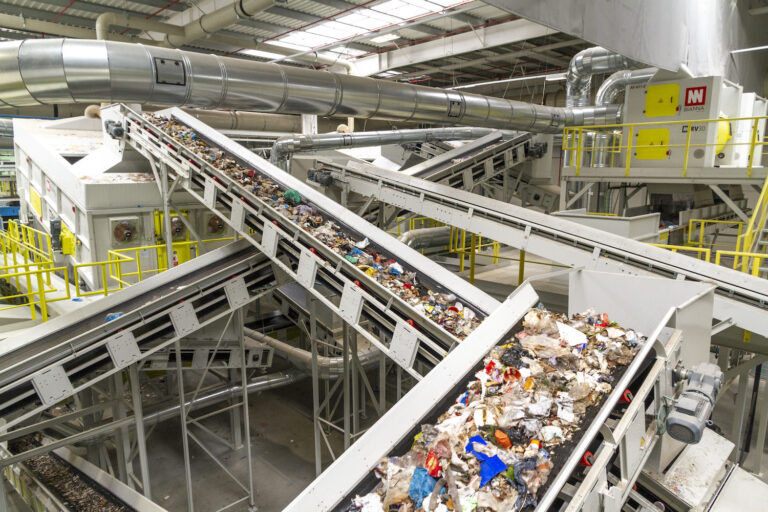
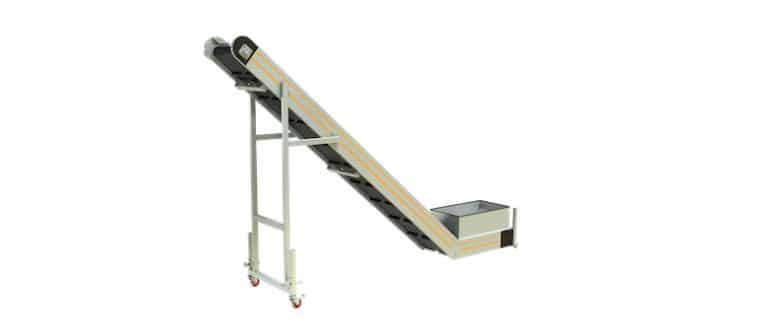
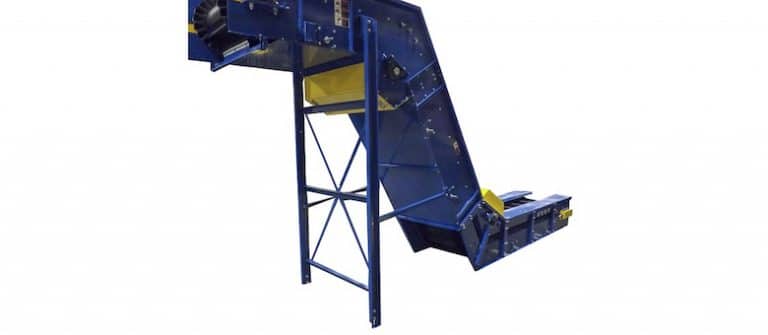
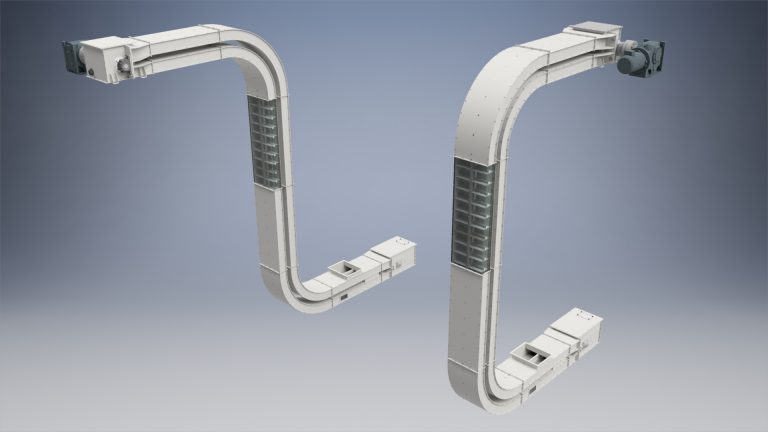
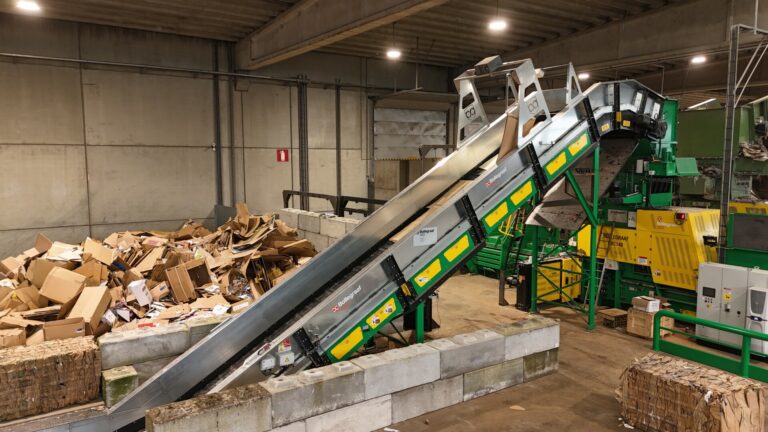
Belt conveyors do most of the work: flat and troughed belts for transport, steep-incline and cleated belts for lifting, chain-belt (steel slat) conveyors for heavy, abrasive or hot material, sorting belts with a flat, slow surface for manual and optical sorting, and acceleration belts that spread material into a single layer before a sensor. Screw and drag-chain conveyors move fines, dust and dense fractions in enclosed casings; vibratory conveyors spread and de-agglomerate.
Feeders set the rate
A sorting line is only as steady as its feed. Metering drums, dosing bunkers with walking floors or chain floors, and bag openers with a metered discharge turn the surges of a loader into a constant stream; that constant stream is what lets screens, magnets, eddy-current and optical sorters run at their design purity. Without metering, every downstream machine is oversized half the time and overloaded the other half.
Capacity, burden and speed
Capacity is belt width times speed times bulk density times burden depth. For sorting, the burden is the limiting factor: a single layer for sensors, a few centimetres for manual picking. Transport belts can run deeper and faster, but speed above 2 m/s dusts and spills at transfers. Steep inclines need cleats or sidewalls above 18–20°, and the chute at the top must not choke on bulky items.
Transfer points
Most spillage, dust, wear and downtime happens where material changes conveyor. Short drops, chutes shaped to the material trajectory, impact beds under the load point, skirting with proper seals, and belt scrapers against carry-back turn a dirty plant into a clean one. Wires, strapping and film wrap around pulleys and rollers at exactly these points; guards, anti-wrap discs and cleaning access are part of the design.
Wear, safety and cleaning
Recycling material is abrasive, sharp, wet and sticky. Belt covers, liners and impact-resistant idlers extend life; rip detection saves a belt when a sharp object goes through; pull-cord stops, guards and lockout are non-negotiable where people work next to belts. Design for cleaning: access on both sides, no hidden pockets, and conveyors that can be emptied at shift end so nothing smoulders overnight.
Key parameters
| Parameter | Typical range | Rule of thumb |
|---|---|---|
| Sorting belt speed | 0.3–0.6 m/s manual sorting; 2.5–4.5 m/s optical sorting | Manual: burden a few cm; optical: single layer |
| Transport belt speed | 1–2 m/s | Above 2 m/s expect dust and spillage at transfers |
| Belt incline | ≤ 18–20° plain belt; up to 45° cleated; 90° with sidewalls and cleats | Limit set by the material's roll-back, not the belt |
| Chain-belt conveyor | 0.1–0.5 m/s; 50–200 t/h | For heavy, hot, abrasive fractions and under shredders |
| Metering drum / dosing bunker | Feed rate variation < ±10 % after metering | The single biggest lever for sorting purity |
| Drop height at transfers | < 1 m where possible | Every metre of drop breaks glass, dusts fines and wears chutes |
| Belt width | 800–1,400 mm sorting; 1,000–2,000 mm optical | Width is chosen for burden depth, not tonnage |
| Idler spacing, loaded side | 1–1.5 m; closer under the load point | Impact idlers or beds at every load point |
Troubleshooting
| Symptom | Likely causes | What to do |
|---|---|---|
| Surging feed to the sorting line | Loader feeding straight onto the belt; no dosing bunker; bag opener discharge uneven | Dosing bunker with metered discharge, metering drum, level control on the bunker |
| Belt mistracks | Off-centre loading; material build-up on pulleys and idlers; frame misalignment; wet one side | Centre the chute, scrapers and cleaning, align frame, training idlers |
| Material wraps around rollers | Wires, tapes, film, strapping | Pre-shredding or bag opener, anti-wrap discs, guards that allow cleaning, scheduled cleaning stops |
| Spillage and carry-back | Overloaded belt; worn skirting; no scraper; sticky material | Reduce burden, replace skirting seals, primary and secondary scrapers, belt with suitable cover |
| Belt rips or cuts | Sharp metal, glass; long drops; jammed objects at transfers | Magnet and metal removal upstream, lower drops, rip detection, cut-resistant belt |
| Roll-back on inclined belt | Incline too steep for the material; wet or round objects; plain belt | Cleated belt, sidewalls, reduce angle |
| Dust at transfers | Long drops; open chutes; high belt speed | Enclosed transfers with extraction, shorter drops, slower belts, fog suppression |
Go deeper: news and case studies · frequently asked questions
Equipment Guide
Conveying and Feeding in the Equipment Guide
14 equipment types
Recommended manufacturers
 Jiangsu Keson Environment Technology Co., Ltd.
 is a high-tech enterprise specializing in environmental protection, industrial, energy, low-carbon intelligent equipment system R&D, intelligent equipment manufacturing, comprehensive solutions of solid waste low-carbon & resource recovery, and investment, construction and operation.
Jiangsu Keson Environment Technology Co., Ltd.
Jiangsu Keson Environment Technology Co., Ltd. is a high-tech enterprise specializing in environmental protection, industrial, energy, low-carbon intelligent equipment system R&D, intelligent equipment manufacturing, comprehensive solutions of solid waste low-carbon & resource recovery, and investment, construction and operation.
 Bollegraaf Group
 is a world-leading expert and innovator in the waste sorting and recycling sector. Furthermore, our reputation is based on the unique quality of equipment in terms of separation performance, robustness, and ease of maintenance. A premium quality complemented by our engineering expertise allows delivering the best solutions to the specific challenges of each of our customers.
Bollegraaf Group
Bollegraaf Group is a world-leading expert and innovator in the waste sorting and recycling sector. Furthermore, our reputation is based on the unique quality of equipment in terms of separation performance, robustness, and ease of maintenance. A premium quality complemented by our engineering expertise allows delivering the best solutions to the specific challenges of each of our customers.
 Eriez
Established in 1942, Eriez is a global leader in separation technologies. Eriez Recycling Products work successfully to separate and recover metals in a variety of applications - from municipal solid waste and shredded automobiles, plastics, electronic waste and foundry sand.
Eriez
Established in 1942, Eriez is a global leader in separation technologies. Eriez Recycling Products work successfully to separate and recover metals in a variety of applications - from municipal solid waste and shredded automobiles, plastics, electronic waste and foundry sand.
 AIK Technik AG
 are a system supplier as a plant engineering for the treatment and recovery of residual materials. We are committed to reducing environmental impact for future generations and to achieving maximum sustainability using specialized processes and technologies.
AIK Technik AG
AIK Technik AG are a system supplier as a plant engineering for the treatment and recovery of residual materials. We are committed to reducing environmental impact for future generations and to achieving maximum sustainability using specialized processes and technologies.
 Machinex Industries Inc.
Machinex Industries offers complete engineering design, manufacturing and installation of Material Recycling Facilities. As a leader in sorting technologies, Machinex Industries provides turnkey systems: Single-Stream, Mixed Waste Processing, Construction & Demolition, Commercial and Industrial Waste, front-end processing for Waste-to-Energy plant.
Machinex Industries Inc.
Machinex Industries offers complete engineering design, manufacturing and installation of Material Recycling Facilities. As a leader in sorting technologies, Machinex Industries provides turnkey systems: Single-Stream, Mixed Waste Processing, Construction & Demolition, Commercial and Industrial Waste, front-end processing for Waste-to-Energy plant.
 CM Shredders
For more than 35 years, CM Shredders has been designing and manufacturing the world’s most advanced industrial shredders and recycling systems. Fueling technology and innovation for today and beyond, CM Shredders has long been at the forefront of game-changing innovations.
CM Shredders
For more than 35 years, CM Shredders has been designing and manufacturing the world’s most advanced industrial shredders and recycling systems. Fueling technology and innovation for today and beyond, CM Shredders has long been at the forefront of game-changing innovations.
 Presona AB
Designed and built in Sweden where the focus is on efficiency, quality, safety and sustainability, Presona balers are the personification of Swedish precision engineering. They are reliable, consistent and efficient. They are also designed to cope with rugged manufacturing, recycling and waste management environments.
Presona AB
Designed and built in Sweden where the focus is on efficiency, quality, safety and sustainability, Presona balers are the personification of Swedish precision engineering. They are reliable, consistent and efficient. They are also designed to cope with rugged manufacturing, recycling and waste management environments.
 Cross Wrap Ltd.
Cross Wrap's speciality is in automated bale handling and material flow solutions for the global recycling, waste, and industrial sectors. It's known for its innovative Bale Wrapping and Bale Dewiring machines, designed to improve safety and efficiency in material processing.
Cross Wrap Ltd.
Cross Wrap's speciality is in automated bale handling and material flow solutions for the global recycling, waste, and industrial sectors. It's known for its innovative Bale Wrapping and Bale Dewiring machines, designed to improve safety and efficiency in material processing.
Ask the Expert
Ask a conveying and feeding expert — free
Engineers and product specialists who answer technical questions from readers. The answer comes back to you by e-mail; when we publish it, other readers benefit too.
 Charles Daridon
Bollegraaf Group
Charles Daridon
Bollegraaf Group
Charles Daridon is the Director Global Sales of the Bollegraaf Group. Charles was born in Bretagne but has been living in the…
Ask a question Daniel Wresnik
UNTHA shredding technology
Daniel Wresnik
UNTHA shredding technology
Daniel Wresnik, Head of Sales and Business Development BU Waste & Recycling in the DACH region at UNTHA, is a proven expert…
Ask a question Xu Xifeng
Jiangsu Keson Environment Technology Co., Ltd.
Xu Xifeng
Jiangsu Keson Environment Technology Co., Ltd.
Xu Xifeng, the founder of Keson and vice president of Jiangsu Low Carbon Environment Design Institute of China. He has been engaged…
Ask a question Laetitia Paveau
Pellenc ST
Laetitia Paveau
Pellenc ST
Laetitia is the Marketing and Communications Director at Pellenc ST. An engineer by training, she has spent over 20 years driving innovation…
Ask a questionMarket & Technology Focus
Conveying and Feeding, in depth in your inbox
Every Thursday edition takes one market or technology in depth. These are the editions on this zone — read them online or get the next one by e-mail.
Subscribe to our E-newsletters
Recycling technology worth your time: new equipment, plant case studies and the numbers behind them. Free, twice a week.
Questions and answers
Frequently asked about conveying and feeding
Why does metering matter so much for a sorting line?
Every sorter — screen, magnet, eddy current, optical — has a purity and recovery that depend on burden depth. A surging feed alternates between an overloaded belt (poor purity) and an empty one (wasted capacity). A dosing bunker or metering drum that keeps the feed within ±10 % lets every downstream machine run at its design point and is usually the cheapest purity improvement available.
How steep can a conveyor run in a recycling plant?
A plain belt up to about 18–20° for most mixed material, less for round or wet items; cleated belts to 45°; sidewall belts with cleats to vertical. Steeper belts need more attention to the discharge chute — bulky items that clear the incline can still choke the transfer at the top.
Which conveyor under a shredder or for heavy scrap?
A chain-belt (steel apron) conveyor: it takes impact, heat, sharp and abrasive material and runs slowly with a deep burden. Rubber belts under a shredder rip on sharp pieces and burn on hot ones; use them only after the material has cooled and coarse metal is out.
How do I reduce belt wear and rips?
Remove metal before it reaches the belt, lower drop heights, fit impact beds at load points, choose a belt cover suited to the material (cut-resistant for glass and metal, oil-resistant for organics), and fit rip detection on long or expensive belts. Most rips start at a transfer where a sharp object gets trapped.
What belt speed for manual sorting?
0.3–0.6 m/s with a burden a few centimetres deep, so pickers can see and reach every item; wider belts with the material spread thin beat faster belts. Good lighting, a comfortable picking height and an even feed matter more for picking rate than belt speed.
How do I stop material wrapping around pulleys?
Take long, flexible items out of the stream early — bag openers, pre-shredders and ballistic separators help — and protect rotating parts with anti-wrap discs and guards that still allow cleaning. Plan short cleaning stops; waiting for the wrap to stop the belt costs far more.
Should conveyors be emptied at the end of the shift?
Yes. Material left on belts, in chutes and in bunkers is where smouldering starts overnight, especially with lithium batteries, organics and shredded material. Run the line empty, look into bunkers and transfer chutes, and let temperature sensors and cameras watch the rest.
What is the difference between this Technology Zone and the Equipment Guide?
The zone is the editorial side: news, case studies, videos, newsletter editions and field experts. The Equipment Guide is the directory side: equipment types and the manufacturers that build them. This page links to its Equipment Guide category and back.
How do I find a manufacturer of conveying and feeding equipment?
Open the Equipment Guide category for this zone, pick an equipment type and open a manufacturer profile. Partner profiles carry direct contact details; other listings link to the company website.
Can I ask a technical question before I buy?
Yes. Ask the Expert puts your question to a field expert in this zone. The answer comes back to you by e-mail; when we publish it, other readers benefit too.